Borrowing from an old Spanish tale, Hans Christian Andersen in the mid 19th Century wrote his clever fable, “The Emperor’s New Clothes.” Andersen may have intended a morality tale to warn children of the folly of vanity and intellectual pride, but of course the tale has equal importance for adults.
The Spanish version dates to the 15th century, and there is an even earlier version from the 13th century told in India. Apparently, vanity and intellectual pride have been around for a long time.
In Andersen’s version, a chiseller convinces a vain leader that he can weave clothes that only intellectually superior people can see, but in truth there are no clothes at all. The king, who believes himself to be intellectually superior, is easily tricked. He refuses to admit that he can’t see any clothes. He “dresses” for a parade and proudly rides through a crowd of his subjects wearing nothing at all. His subjects don’t want to look stupid so they go along with the fakery. But an innocent child looks at the ruler and speaks the truth that he is naked. The king and all his reverently servile followers are, shall we say, suddenly exposed.1
Andersen may have been inspired by his own childhood experience when, at a royal procession, he saw the king and exclaimed that he was “only a man.” Leaders, whether kings, presidents, czars or politicians, can seem bigger than life, almost god-like. Some like to present themselves as such, and not unlike the emperor’s subjects, some even think their leader is god-like. It can take the perspective of a child (or a poet, or an artist, or a cartoonist, or a satirist) to point out the fraud of a pompous leader.
In the last century, similar ideas2 were expressed by Mahatma Ghandi, Nelson Mandela, Archbishop Desmond Tutu, the Dalai Lama, and John F. Kennedy. Kennedy spoke about Robert Frost in his last public speech, given at Amherst College, saying artists and poets constrain abuses of power:
“When power leads men towards arrogance, poetry reminds him of his limitations. When power narrows the areas of man's concern, poetry reminds him of the richness and diversity of his existence. When power corrupts, poetry cleanses. For art establishes the basic human truth which must serve as the touchstone of our judgment.”3
By contrast, American people have just this week honored a President who wasn’t as big on himself as one who preceded him or as is the current President-elect. Even so, Jimmy Carter was often the subject of political cartoons. Herb Block, one of the more famous cartoonists of the time, caricatured Carter and depicted him pounding on his desk while insisting he was the man in charge in Washington.
Herb Block openly questioned Carter’s management style. A Washington outsider, Carter had somewhat comically overstepped when insisting on his importance. Powerful people sometimes don’t like the truth about themselves, but as far as I recall Carter didn’t threaten the commentators. I don’t recall, either, that he expected rich people to pay large sums of money to his inauguration ceremony. Times and leaders change, and now we have a much different tone to reckon with.
Herb Block was legendary. Here is the late and former chairman of the Washington Post, Katharine Graham, speaking about him:
Herb fought for and earned a unique position at the paper: one of complete independence of anybody and anything. Journalistic enterprises run best when writers and editors have a lot of autonomy. But Herb's case is extreme. And because he's a genius, it works.
Since he arrived at The Post, five editors and five publishers have learned a cardinal rule: Don't mess with Herb. He's just as tough within the confines of The Post as he is in the political world outside. Of course, this has produced a few tense moments.
I have sometimes opened the paper and gasped at Herb's cartoons, particularly during Watergate when we were so embattled on all fronts. But I learned not to interfere. And anyway, most of the time we're on the same wavelength. Even when we aren't, I should confess, I generally find myself laughing uproariously at the cartoon that has caused my apprehension. In this sense, Herb always wins.4
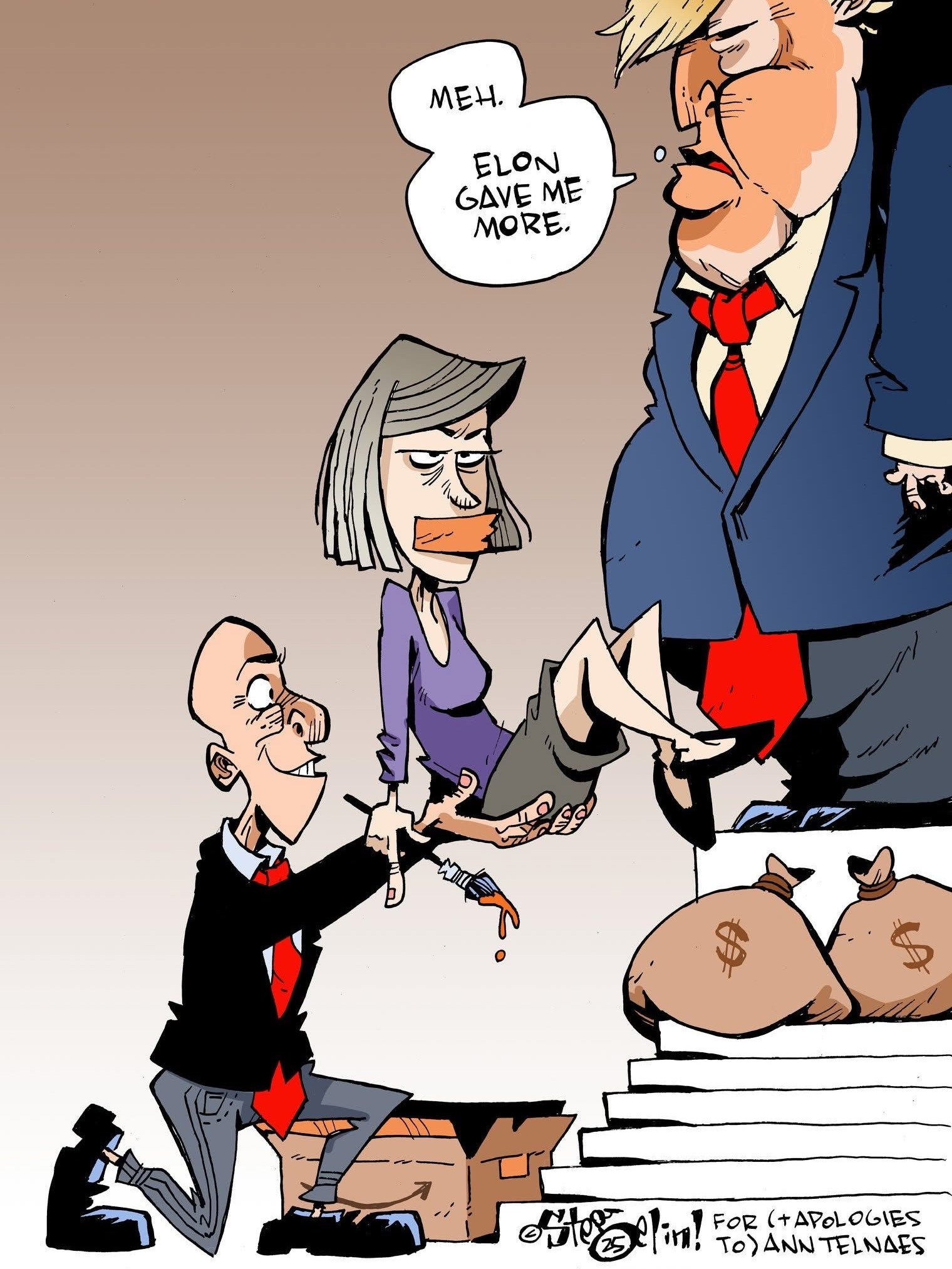
Recently, another fine political cartoonist decided to quit her job with the Washington Post after it spiked a cartoon she had sketched, apparently because it spoke more truth to power than her editors felt the owner would tolerate. Her name is Ann Telnaes, and her cartoon suggests that the owner of her newspaper, Jeff Bezos, is among a gaggle of billionaires currently sucking up to the president-elect. She has turned to Substack and is finding an audience potentially much bigger than that of the Post.5 She has even “loaned” her idea in sketch form to other political cartoonists who have added their own very clever twists. One of my favorites is drawn by Steve Stegelin; it shows Bezos offering Ann Telnaes herself to the wannabe tyrant.6 Not only is Ann Telnaes’s voice not silenced, it is thankfully amplified. But not at the Washington Post, which seems to have left behind its tradition of autonomous cartoon commentary.
I fear that younger people will not understand the importance of her decision to quit her job because her boss canceled her work. High principles are among the factors that lead to her decision. Still, the owner of a business certainly has the right to do with it as he or she wishes (within the bounds of the law). But a newspaper is not an ordinary business, as she points out.7 Newspapers have been so highly regarded as a pillar of American democracy that they are even protected in the First Amendment to the United States Constitution. Even the motto of the Washington Post suggests the importance of a free press: “Democracy Dies in Darkness.”
To be fair, Mr. Bezos isn’t the person who spiked her cartoon idea; his editors were. They have cited other reasons for killing the idea.8 As had been the practice, they could have asked her to work on it. Bezos’s editors may or may not have been thinking of him when they axed her idea, but they certainly weren’t thinking of Katharine Graham. In my opinion, the lot of them aren’t thinking clearly about what the times and the Post’s tradition require. They are not worthy to operate the Post if they, for whatever reasons, shy from speaking truth to power.
It has become increasingly difficult to distinguish “freedom of the press” from “free speech.” Most commentary now is in speech form rather than printed form and the two are commonly conflated. With the venom spewing unchecked from social media platforms, one might wonder if decoupling is warranted. A quick comparison of the relatively tame cartoon sketch of Ann Telnaes to the daily libelous and slanderous rants of the president-elect reveals completely different standards.
As a reminder, the First Amendment says, “Congress shall make no law respecting an establishment of religion, or prohibiting the free exercise thereof; or abridging the freedom of speech, or of the press; or the right of the people peaceably to assemble, and to petition the Government for a redress of grievances.”
With Ann Telnaes and her cartoon idea, the issue isn’t that Congress is about to make a law abridging the freedom of the press. What she is suggesting is that a tyrannically inclined leader can and has intimidated newspaper owner Jeff Bezos and others into obeisance. We can be glad that she has found a podium on Substack where her fears and ideas for her country can be displayed. She will have autonomy on Substack, and she very well may be paid more handsomely for her work.
The disgraced Post leaders, meantime, can review some of the history of the First Amendment9, the words of the newspaper’s legendary editors and publishers, and their own hearts to see if they belong in an honorary profession or one where truth should be told only when the emperor and his suck-ups approve.
https://andersen.sdu.dk/vaerk/hersholt/TheEmperorsNewClothes_e.html ↩
https://en.wikipedia.org/wiki/Speaking_truth_to_power ↩
https://www.arts.gov/about/kennedy-transcript#:~:text=If%20Robert%20Frost%20was%20much,fibre%20of%20our%20national%20life. ↩
https://www.herbblockfoundation.org/herb-block/biography ↩
- Why I'm quitting the Washington PostI’ve worked for the Washington Post since 2008 as an editorial cartoonist. I have had editorial feedback and productive conversations—and some differences—about cartoons I have submitted for publication, but in all that time I’ve never had a cartoon killed because of who or what I chose to aim my pen at. Until now.

Steve Stegelin (with permission)
https://substack.com/@stevestegelin708190 ↩
- Interview with BBC World Service Radionull

https://www.thedailybeast.com/wapo-editor-explains-decision-to-ax-bezos-trump-cartoon/ ↩
https://constitution.congress.gov/browse/essay/amdt1-7-1/ALDE_00013537/ ↩
Truth must speak to Power
Especially when the Emperor has no clothes