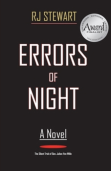
Errors of Night
About: Using interior monologues from each of its five characters, Errors of Night explores the regret of a former Nazi general, the self-doubt of a speechless and disabled Italian Marchesa, the deep resentments of an elderly Italian partisan, the choices of a mid-life caregiver, and the questions of a Benedictine priest. Stewart's book ventures deep into the souls of each with insights that will bring readers to the edges of their own self discovery.
Excerpt: Dani made that painting while we sat at the edge of the grotto where the leaves of the giant bay bathed yellow in the morning sun. The other children played. He would not look at me; he was too shy. He hummed while he drew. A strange image I could not recognize lifted from the paper as he worked, and it did not matter if I did not recognize the image, because to me it was all exceptionally beautiful. I enjoyed his way of working. He heard colors, a genius. Dani was a genius. His drawing of me was not a normal child’s work but full of suggestion and meaning. I dream of the sounds associated with the various colors. It takes a dream to discover the association. When I am awake, I cannot link a certain sound with a certain color. I am not good at sounds. I have a love of silence. It takes silence to hear. Mother says the mere squeals of children, such as when they bolt into a room and find their grandmother knitting skeins of colored thread, can be delightfully complete expressions. She credits Virginia Woolf; it sounds like something she would say. Is this what Dani heard when he saw the colors? Gleeful little squeals of life?
The finished drawing is lodged in my mind, but sometimes when I am tired from a long day of work, I suspect I do not properly remember it. Then when I wake, maybe after dreaming, I see the image as I lie face up, my eyes closed against the daylight prying from behind the shutters.
Analysis by Artificial Intelligence platform Perplexity:
Errors of Night is best read as a novel of moral aftermath. It asks whether remorse can become meaningful repair after historical violence—or whether it remains, unavoidably, too late. Its five interior monologues make that question plural: no character possesses the whole moral truth.
Narrative Design: The novel’s present-day encounter is built around General Julian von Wille’s return to Italy, decades after the 1944 Cassino campaign, to return a satchel containing a rare Shelley poem and artwork taken from the wounded Marchesa. His priest-son accompanies him, while the Marchesa—now physically disabled and unable to speak—must confront the visitor’s return.
This narrative design makes the book less a conventional wartime chronicle than a trial without a courtroom. Each first-person account functions as testimony: subjective, interested, wounded, and partial. The result is a moral counterpoint in which personal memories neither align neatly nor permit a single verdict.
Guilt and forgiveness: Von Wille’s guilt is serious because it is not abstract: he took possession of the satchel amid war, and his tactical role in the retreat brought destruction. Yet the novel does not allow him an easy repentance plot, because a returned object cannot restore lives, health, or time. The Marchesa complicates the ethical balance further. She is not simply an injured recipient of another person’s apology; she is burdened by her own remembered losses and by having failed to save children at her orphanage. Thus the novel treats war trauma as a shared field of damage while preserving differences in responsibility.
Silence and voice: The Marchesa’s muteness is the novel’s sharpest formal irony: a book constructed from interior monologues gives crucial inward life to a woman whose outward speech has been removed. Her consciousness challenges the assumption that silence equals passivity or forgiveness. The other voices—the general, the elderly partisan, caregiver, and Benedictine priest—put competing moral languages into play: resentment, duty, spiritual judgment, care, and remorse. The book’s structure implies that reconciliation requires listening, but it does not promise that listening will produce absolution.
Art and restoration: The stolen Shelley poem and artwork are not mere historical curiosities. They embody cultural memory: fragile objects that survive violence while also recording what violence tried to seize, possess, or erase. Returning them is meaningful, yet the novel keeps the act morally insufficient; art can preserve testimony but cannot cancel atrocity. Music provides a more immediate possibility of communication. The general’s musical background and an old harpsichord are presented as a possible route toward amends, suggesting a form of expression that can cross the Marchesa’s enforced silence without pretending to speak for her. This is why a Liszt reference matters: the music’s darkness and elegiac inwardness resonate with a novel in which memory returns as a pressure rather than a solved problem.
History and landscape: Monte Cassino’s destruction, Nazi looting, and Allied bombing give the novel historical gravity. The book uses these factual wartime events as the setting for fictional moral inquiry rather than treating the past as scenic backdrop. The Italian landscape is more than picturesque. Its gardens, villa, and damaged rural world register the contrast between cultivation and devastation: human beings attempt to tend, preserve, and make beauty, while war turns places and people into ruins. Kirkus particularly notes the novel’s poetic descriptive style and historical command, although it also finds some monologues—especially the gardener Attilio’s—occasionally over-grandiose.[kirkusreviews]
Central tension: The title’s “errors” are not only battlefield mistakes. They include theft, compliance, failures of courage, failures of protection, and perhaps the mistaken belief that one late gesture can settle an old account. “Night” names both literal wartime darkness and the inward obscurity in which people rationalize, repress, or cannot fully understand what they have done.
The novel’s most demanding claim is therefore not that forgiveness redeems the guilty. It is that human beings must still undertake confession, return, witness, and care—even when repair is incomplete and forgiveness remains entirely the injured person’s choice.
Sample Reviews:
Kirkus Reviews:
In Stewart’s historical novel, an aging Nazi general returns to Italy in search of forgiveness for an act he committed during the war.
Presiding over the Italian Cassino battlefield in 1944, German Gen. Julian von Wille leads an army in retreat. Tasked with slowing Allied advances, his tactic is to “introduce complications” by means of destruction. Amid the chaos, he takes possession of a satchel, containing a rare Percy Bysshe Shelley poem and an unusual artwork, found on the wounded body of a marchesa.
After shouldering the burden of guilt over this theft for 40 years, von Wille returns to Italy with his son, a priest, to return the satchel. He finds the marchesa paralyzed by her wartime injuries and rendered mute by a subsequent stroke. The elderly woman is also tormented by the horrors of her past, having lost two of the men she loved to the war and having failed to save the lives of the children at her orphanage.
The general’s musical background and the discovery of an old harpsichord may hold the unexpected key to making amends. Stewart’s novel draws on factual wartime events, particularly the Nazi looting and subsequent Allied bombing of the Monte Cassino monastery, to skillfully weave a gripping fictional narrative that examines remorse and reconciliation.
Written in the first person from the perspectives of the marchesa, the general, and others, the novel takes on a confessional quality. Stewart has a vivid descriptive style that often borders on the poetic: “The war came, burrowing beneath our skins like ticks.” On occasion, the author over embellishes his tale with grandiose monologues improbably assigned to characters such as Attilio, the gardener: “I am God’s own angel tending the garden of His troubled children.”
However, this remains an emotionally complex, finely wrought novel that keeps readers guessing until the very end. Stewart’s poetic flair for detail and firm grasp of military history make for a truly compelling read.
~~~
"...how often does a reader have the opportunity to look into another's soul?
The conflicts - war vs. peace, conflicting memories, trauma, redemption, chastity vs. love, honor vs. duty - combine to create the conflicts and mystery of being human ... Stewart's language is poetic, and his metaphors are remarkably creative, weaving a rich tapestry of prose, doubling the reader's sheer pleasure.
– John (JB) Winsor, author of River Stone, Love of the Hunt, The Punishments and Maggie’s Revenge.
"... compelling characters in their search for reconciliation, forgiveness, and peace in the aftermath of the Second World War’s devastation to a small village in Italy. Stewart writes a literary prose to delight the senses. It is a novel to be savored.
– Richard Stephen Scheideman
"Captivating story... every word adding value. None wasted. There are five characters, each of whom is fully formed, sympathetic, flawed and very real. A wonderful read that will have one going back to reread passages for the enjoyment of Stewart's lyrical wording.
-- R. Alan Rudy
"I loved learning about the different perspectives of the war from the safe emotional distance of a few decades later, and being able to recreate the big picture in my head through the personal experiences of diverse people. A wonderful weave of stories that creates a fantastic counterpoint!
– H. Kellogg