The medium and the message
How sickness can sharpen one's point of view
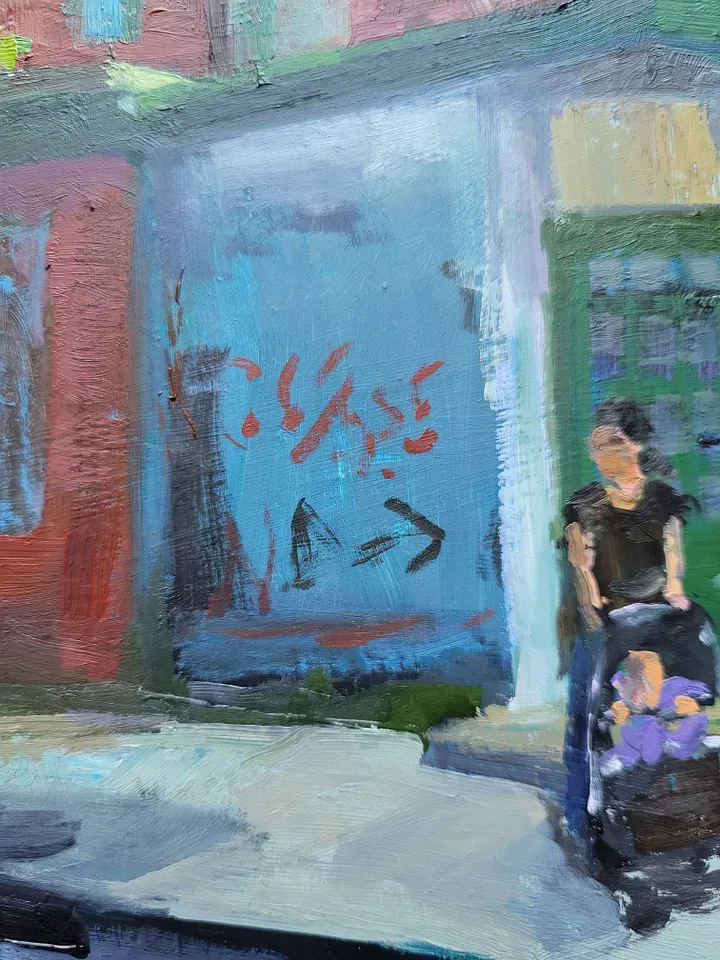
Used by permission. 5th Street (Ghost Sign), 16 x 20 inch, oil on panel, by Kate Kern Mundie
FOR TEN DAYS I have fought pneumonia. I don’t care to whine about it, and in fact, I am not in favor of bringing it up at all. But here I am, using the first person to introduce an idea. Shamelessly I write about my tussle with a tiger of illness. Oh, this was not a very serious illness. A battalion of antibiotics came to the rescue quickly, blocking the onslaught like Wilt Chamberlain’s giant hands on the basketball court years ago. But at 79, I am aware that there will one day be the last illness. Not a case of measles or a fling with the flu from which I recover. But the Big One from which there is no exit.
So, against this grim backdrop I wish to discuss Marshall McLuhan and an artist I don’t even know who lives in Philadelphia. Her name is Kate Kern Mundie.1 She describes herself as a fine artist focusing on evolving landscapes. Her Substack caught my attention as I lay in bed because of the ordinariness of the landscape she had depicted: A woman with a pram in front of a corner storefront somewhere in American, maybe Philadelphia, a postal box, a few parked cars, brightly colored buildings, one defaced with graffiti. She comments on her own work with these remarkable sentences:
This layered, textured quality of graffiti reminds me of the thick, crusted surfaces of urban landscapes—built up with paint, pollution, and human intervention. As I paint these scenes, I find myself thinking about how the city’s surfaces tell a story shaped by countless voices. Capturing graffiti in my paintings is a way of acknowledging those voices, even when they’re not immediately visible.
Her essay, like her artwork, is remarkable. She evokes the famous philosophy of the 1950s and 1960s from Marshall McLuhan,2 a Canadian philosopher who coined the term “the medium is the message.” Much has been written about his philosophy, but I haven’t read anything quite so insightful as Ms. Mundie’s brief comment and demonstration. From the detail above, used with her permission for this post, one is easily transported to a depth of possibility. In my case, I lay in exasperation at the void of energy and acuity, staring at the colors, thinking of the artist’s skill at mixing gessoes and hues, of the artist’s ability to see profound ideas lying on top of urban blight. Perhaps it took the illness to sharpen my senses; I don’t know. To think of the layers of ordinariness, the decades of revision, the coats of paint selected on whims and preference, the illegality of graffiti announcing itself in garish protest or in selfish assertion of individuality, all of it taken together with worshipful care is to awaken to a communication at the deepest of levels. She says:
My recent urban landscapes reflect this exploration as I learned to work with a new surface feel and paint thickness. This change prompted me to think about the textures and layers present in my landscape views. I’ve been incorporating graffiti as part of the visual narrative. Graffiti is inherently about the medium being the message: it’s often illegal, layered on walls already textured by damage, stucco, or rusted metal. The graffiti itself can be a name, a political statement, or a series of symbols meaningful within a specific community. It becomes part of the city’s surface—a voice embedded in the urban environment, whether we see the person behind it or not.
With my grim self-awareness, I cannot help but be reminded of William Faulkner’s “As I lay Dying,” his short novel about an old woman’s final journey. Perhaps like Addie Bundren, one is bourne at times by caring friends and family who wish to say somehow that life just doesn’t make much sense. Like their love, colored in mishap and humor, derailed by circumstance, frustrated by frailty, or marred by misadventure, the shades of human kindness are to an ailing soul like a deep green, a bright yellow, a burnt orange or a soft ocher to an artist, extending warm arms and whispering a soft message that rests profoundly in the medium.