Sun Dog morning
How about this strange morning greeting?
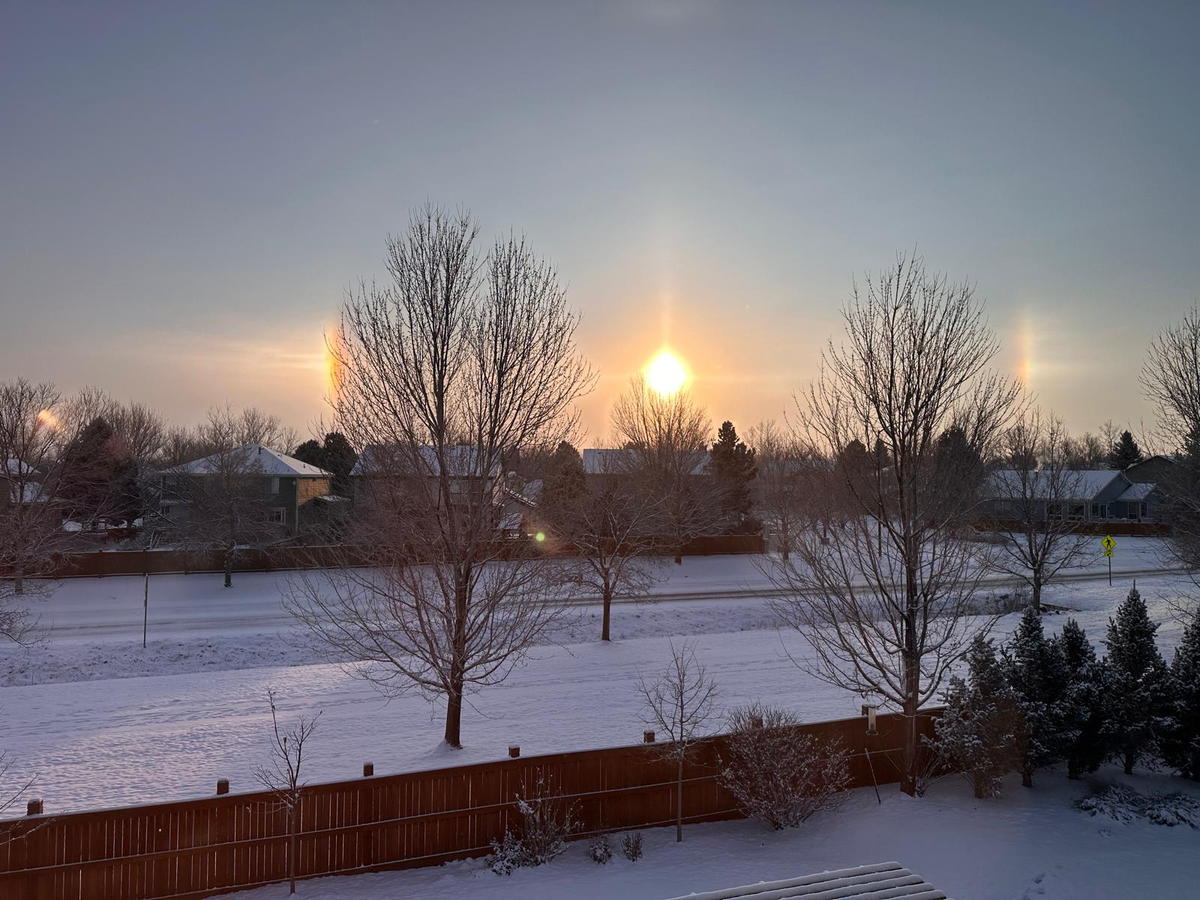
Photo by Irina Schwarzburg. Used by permission.
MY DEAR FRIEND and daughter-in-law awakened to this remarkable view out her bedroom window a couple of days ago. As if one sunrise isn’t enough on a freezing morning, this day presented three of them. I wish I’d seen it, but I normally don’t rise as early as she does, and besides I live in a different community.
It’s called a Sun Dog. According to a quick search on the artificial intelligence platform called Perplexity, Sun Dogs aren’t that uncommon especially in cold mornings. Also called parhelion, the triple sun is a result of light passing through ice crystals, which is then refracted and appears as bright spots on either side of the Sun. Each is at about 22-degrees off, and the three suns appear to be on the same plane.
So goes the physical explanation, but for an active imagination, there are all kinds of not-so-scientific possibilities, such as things are so weird in the world right now that three suns are offered instead of one so that humans can take solace. Things often feel good when the warm sun eases the bite of a winter morning, so it must be three times as good if you jazz it up with a couple of Side Suns. And these Side Suns might be like bookends, propping up the many promises of a new day like volumes of Shakespeare on a bookshelf. Or maybe they’re like cold hands at each side of a cup of hot coffee. Or maybe like the three-dog night that a 1960s folk singing group evoked to suggest benefit of a few warm hounds on a cold night.
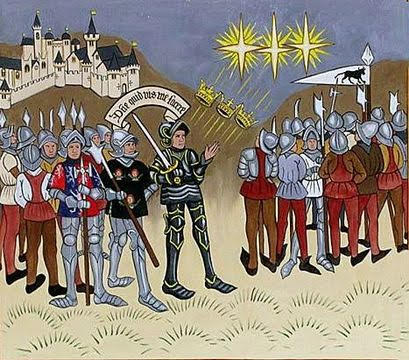
In British history, my learned friend who lives near Florence, Italy, tells me, the Sun Dog was a factor in the battle of Mortimer’s Cross in 1461. A youthful Earl of March, Edward Mortimer, led a small army of Yorkist supporters against Jasper Tudor and his Lancastrians army. Then, on “the Monday before the day of battle, . . . about 10 at the clock before noon, were seen 3 suns in the firmament shining full clear, were of the people had great marvel, and thereof were aghast. The noble Earl Edward them comforted and said, 'be of good comfort and dread not; this is a good sign, for these three suns betoken the Father, the Son, and the Holy Ghost, and therefore let us have good heart, and in the name of Almighty God go we against our enemies.' Edward was victorious and he was soon on his way to the crown as King Edward IV. 1
Shakespeare seized on the symbolic imagery in Act Two Scene One of Henry VI, Part 3:
King Edward IV (Plantagenet): Dazzle mine eyes, or do I see three suns?
What ideas do you have? Does this odd display of simple physics remind of family? Of conversation? Of friends at our sides when times are difficult? Of prayers at our hospital bedside as we recovered from surgery?
Or maybe such natural gifts do not require words so much as quiet reflection. For reasons that escape me at the moment, I’m reminded of the duck blinds my father and I built years ago on the Loup River in Nebraska, so that we could go out before dawn with our shotguns and our thermoses and shiver in the mist while calling ducks and geese to within shooting range. Invariably, as the waterfowl began to set on the water, we’d rise to shoot and then just lower our guns and watch. A poor pair of Ernest Hemingways were we, taking no joy in interrupting the natural scene but gobsmacked by the beauty of it placed before us like artwork. The unspoken question was, why would we upset the natural order? And I might get weepy now, thinking of the love I felt for my old man, and maybe he for me. All that was well beyond words then, and we didn’t talk, because we were simply in the moment.
Three suns on a wintry morning when all else seems pointless perhaps is the only point that needs to be made. So, I will stop now, and wish you a most lovely morning and a Happy Valentine’s Day.