“Did you ever think your entire life is a play and that, you know, 99 percent of the people in it they got no lines, you know? They’re just like extras. And you, you’re just an extra in their play?” — Eddie
I WAS A SUPER.
Three times. True story.
”Super” is short for supernumerary, which comes from the Latin word supernumerarius. It is the word for someone who appears on stage in crowd scenes or in non-singing small parts. In movie scripts, the term is extra. In short, a super and an extra are persons present but not essential.
The line at the top of this essay is said by Eddie, the bartender in the new film called Blue Moon. The line was written by Robert Kaplow and delivered by actor Bobby Cannavale. 1 2 Eddie’s line reminds of Shakespeare’s As You Like It, in which the character Jacques says:
All the world’s a stage/And all the men and women merely players/They have their exits and their entrances/And one man in his time plays many parts…
In my earliest moment of non-essential presence, I was an extra in Episode 5 of the television series Centennial. I elbowed my way close to the camera for reasons best forgotten:
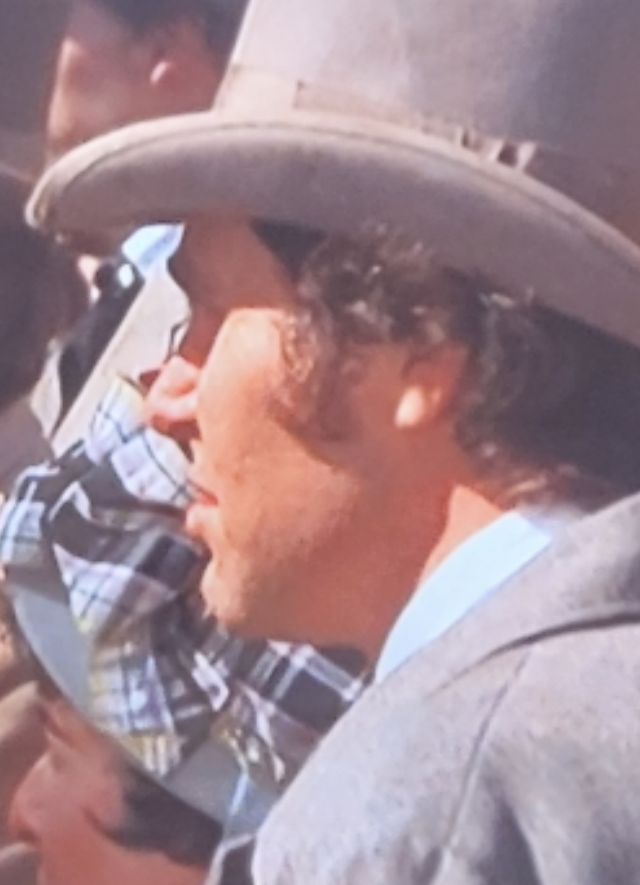
I was part of a crowd supporting the ruthless John Skimmerhorn, a James Michener character modeled on the real-life John Chivington, whose life darkened Colorado history, because he was responsible for the horrific Sand Creek Massacre. 3 In two other non-essential and fake lives, I was the “livery man” who took Cinderella to the ball in the opera, Cendrillon, and an unimportant aristocrat who attended a party in Die Fledermaus. Both operas were admirably performed by very essential students in the University of Colorado’s College of Music opera program.
Episode 5 of the television adaptation of Michener’s Centennial aired on Nov. 11, 1978. 4 Cendrillon was performed 55 years later by the students at CU.
(You can see a Metropolitan Opera video presentation of Cendrillon on Valentine’s Day in many cinemas across the country. 5 If you have a chance, see the movie, “Blue Moon,” now streaming on Prime Video. Episode 5 is referenced in the footnote 4, below.)
As far as any of this involves me, none is important. But it’s the existence of my own non-essential and fake lives that prompted me to think about art, acting, history, and consciousness. Why is it that we have sufficient consciousness to be entertained by and learn from stories? Why do we have consciousness at all?
Consider the images from the trailer (footnote 5) of the Met’s big-screen production of Cenrillion, where a beautiful “carriage” is pulled by four identical “horses.” Neither the horses nor the carriage is real. It’s theater doing what theater does so well: causing audience members to suspend their disbelief and settle in for a lie. I use the term “lie” for the purpose of shock by overstatement. Theater goers know they’re being lied to, and they delightfully accept the delusion. They even pay good money for the privilege. Why would they do that?
I know, and perhaps you do too, people who are uninterested in literary fiction. They would rather learn something worthwhile, facts and history, not imaginary things with little edification. What’s the point?
Well, as a matter of fact, what is fact?
With this backdrop, let’s turn to the the concept of consciousness. Here is a definition of consciousness as given in a recent article in the magazine Scientific American:6
Consciousness is all you really know. It’s the voice you hear in your head, your emotions, your awareness of the world and your body all rolled into one unified experience.
This suggests that my non-essential and fake lives have become part of my existence. In a complex way — one not yet understood — these experiences have become a component of my “soul,” but saying so involves presuppositions best left to philosophers and theologians. From the article in Scientific American:
Many philosophical traditions have dealt with this apparent disconnect by saying the mind—or the soul—is not made of the same physical stuff as our bodies, a position called dualism. Science has instead flourished by assuming the opposite and siding with a theory called materialism, which presumes that everything we observe somehow arises from physical matter, including consciousness.
Maybe so, but when scientist Marcello Massimini, a neurophysiologist at the University of Milan, held a human brain in his hands, his own consciousness swizzled like an olive in a dry martini:
What he alludes to is that the material in the human brain holds a lifetime of experience, memory, and consciousness. While much has been learned about the electrical and chemical activities in the brain, little is known about how it encompasses an individual’s awareness of his or her own reality. As the article in Scientific American explores, there is progress but nothing definitively verified by science regarding consciousness, much less “soul.” The ongoing investigation might even be in jeopardy, the magazine writer says, because some view the research as pointless. Why expend resources on something that may not exist?
The issue won’t simply disappear, however, because the question of consciousness has become central to the the exploding capacity of artificial intelligence. Is AI sentient? The answer is yes and no, depending on who is asked:
This struck thinkers such as philosopher David Chalmers as odd. “No one can say for sure they’ve demonstrated these systems are not conscious,” he says. 9 Absence of evidence is not evidence of absence, as scientists sometimes assert. Nothing has been proved about AI consciousness partly because no one has sufficiently defined it.
Having mulled these ideas over for this essay, I decided to lie down for an afternoon nap, an activity which promises little productivity. But as I lay there in the afternoon sun with thoughts of a brain in a scientist’s hand, I imagined me holding my own brain in my hands, perhaps standing at the “pearly gates.”
“This here brain,” I might mutter to St. Peter, “has left behind its embodiment. That body stuff is useless, but this here brain remains. It’s what told me who I was, what I’d done, whether my decisions were right or wrong, good or bad, and here I am wondering what you might make of it.”
Oddly, it occurred to me that if my non-essential and fake life as an extra in Episode 5 of Centennial found me cheering on an immoral man who would soon be responsible for the massacre of hundreds of innocent men, women, and children of Cheyenne and Arapaho descent, does that make me complicit? And what of Cinderella? My fake and non-essential character took her to the ball so she could have the thrill of her life! So, do I get some credit for getting her out of there before midnight?
Well, of course, my “reality” is only a memory of a movie and a couple of operas. That’s not real.
Except for the part about it being stored in my grey matter. That’s real. Shakespeare said, all the world’s a stage, and Eddie added that most of the people in your personal stage play are extras. And you? Well, you’re just an extra in their life, so there you go.
Dark as that seems, let’s have a different look at reality: No, the imagined and staged events are not real, but yes, the memory of them is.
And what I am responsible for is the meaning I glean from them. It’s what I take away from these moments of non-essential play acting that matters. And, without a whole lot of reflection, I can assert that the Chivingtons of the world — the ones who would “cleanse” their lives of unwanted people, are despicable, and history will remember them as such. And those “insignificant” people who attend to those “principal” characters at center stage may seem “non-essential” but actually they aren’t. The complete production depends on them.
So, let’s have more extras and supernumeraries! Let’s prop them up with catchy pep talks and motivational seminars that show us, and them, that we’re all contributing to one another’s lives and each other’s stash of meaning. Let’s applaud each other’s play, and wish each other well with their antagonists! Let’s cheer each other on as we fight battles with demons, rescue damsels in distress, and make complete the lives of explorers and warriors! Let’s live our lives as though the dramatic tension depends on us!
Toi toi toi!
https://www.screendaily.com/features/blue-moon-screenwriter-robert-kaplow-on-how-he-made-ethan-hawke-cry/5212357.article ↩
https://www.metopera.org/discover/video/?videoName=icinderella-live-in-hd-i-encore&videoId=6387269828112 ↩
https://www.scientificamerican.com/article/what-is-consciousness-science-faces-its-hardest-problem-yet/ ↩
https://www.scientificamerican.com/article/what-is-consciousness-science-faces-its-hardest-problem-yet/ ↩
https://www.scientificamerican.com/article/what-is-consciousness-science-faces-its-hardest-problem-yet/ ↩
https://www.scientificamerican.com/article/what-is-consciousness-science-faces-its-hardest-problem-yet/ ↩
Persons present but not essential
Is it true that what folds into our consciousness becomes our soul?