On the subject of choice
Or, the resilience of free will
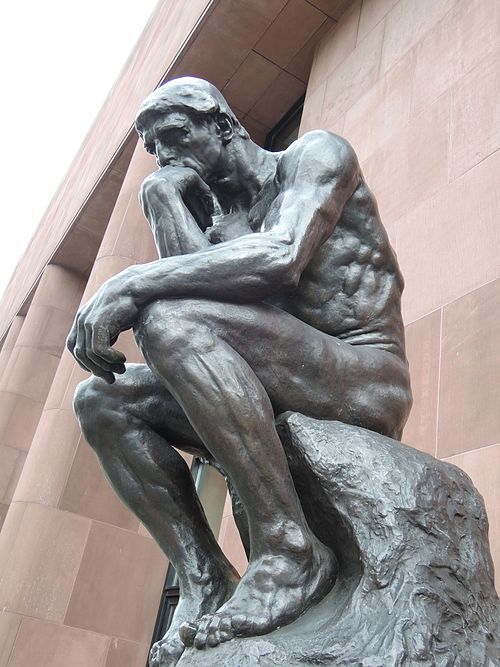
The Thinker by Auguste Rodin
LAST FALL I wrote about a friend who is in his 90s. His interest in my granddaughter and her ambition to study science at university led to his gift to her of a book about cell and molecular biology. He had never met my granddaughter, but he was eager to reach out to a young woman who shared his love of science.
Today I have a couple of updates. First, my granddaughter is enrolled for fall term at a western university where she will study astrophysics. Yes, this is a change from her earlier interest in molecular biology, but she’s young, intelligent, ambitious, and strong minded. She can do whatever she wishes, right?
Her change of heart was greeted as good news by my friend, too. One of his areas of accomplishment is astrophysics, but he’s interested in lots of things. He summarizes his curiosity by using the acronym “LOL”, which for him means love of learning.
So, the other update regards my friend. He has fought a variety of cancers over several years, but now his doctors say there is little more that medicine can do. I know about this because he told me and our group of friends who meet each Wednesday for coffee and conversation. With him, we men held back tears.
This is the truest of friendship, and let’s say so: It’s not too common among men. For whatever reasons, men are often more comfortable with ideas and facts than they are with emotions, especially regarding how they might feel about their family and friends. As C. S. Lewis said when writing about grief, “Feelings and feelings and feelings. Let me try thinking instead.”
We are a group of guys who like ideas and thinking. We have no agenda, but each week we find something engaging to discuss, maybe science, politics, literature, education or philosophy. Maybe all of them and other topics, too. On this day we had been discussing the term “agency” and how it is used in a philosophical sense. One of our group, in his 80s, had written an essay on the theme of agency that, he argued, runs through three books by Kazuo Ishiguro.1 In his view, the three books should be taken as a trilogy, even though the settings and plots are quite different. What’s “agency” in this context? As one of our coffee guys said, you can think of “agency” as free will. It’s the ability to act independently, make choices and control one’s own actions and decisions.
For me, the discussion was eye-opening, especially when it comes to artificial intelligence. Agency is foundational to concepts of responsibility, moral action, and participation in society. It presumes a world with other agents and an external reality in which actions have effects.2 Does AI have agency? What if AI doesn’t now have agency but someday will? If so, how will it be controlled, and if not controlled, what?
So there we sat with a gaggle of ideas running through our heads when our friend abruptly announced that the medicines he had been taking weren’t doing the job.
“I’m on my own,” he said.
A long moment of silent consideration hung over us all. And then one spoke.
“But my friend,” he said; “you’ve been ‘on your own’ before. You’ve fought cancer for years and you’ve had success — you’re still with us! How do you do it? Will you do it again?”
Our friend looked courageously into the eyes of his questioner, and then around the table where sat his long-time friends. I will report using quotations, but I’m sure I don’t have it quite right. Somehow, his body language, facial expression, thinning frame, and tearing blue eyes added nuance that informed beyond words.
“I choose to turn away from the negative thoughts. If I dwell there, I get depressed. So I choose to direct my brain as I’ve always done — toward learning. I engage my brain in projects and that keeps it busy. That’s why I have adopted a routine of life-long learning.”
On the way home, he asked me what I would be doing with the balance of my day, and I informed him of the activities I planned, preparing the house for my partner’s return from her travels, gardening chores, and writing. I returned the question to him, and he told me he needed to reorganize his medicine regimen using a worksheet he had prepared. Of course, he would have his medicine regimen on a worksheet, organized so he could maintain proper schedule as well as to help keep his physicians updated.
“And then I can do what I really look forward to. I’ll get on with my interaction with ChatGPT. I prompt it for book and article reviews to help me prepare for my ongoing discussion and debate with my philosopher friend.”
If I needed any more explanation about agency, here it was. In the face of extreme difficulty, even mortality, one has choices, and they can be powerful to influence one’s environment, destiny, and health. It would be perfectly understandable, at least to me, for him to permit resignation instead of activity. His choice to engage, to willingly turn his thoughts to additional or even new concepts and ideas, is interesting on several levels.
For one, notions of “quality of life” usually refer to some physical activity that illness or age obviate. Not so commonly is reference given to mental activity, even though we have amazing examples such as the late Stephen Hawking, who had little apart from his mind. A nephew of mine had an excellent life despite an accident that took away his mobility. Left with his mind instead of his imposing former physicality, he chose advanced education, eventually achieving his doctorate and a career as a university instructor. There are many more examples, often inspirational.
With choice, one acknowledges the workings of the mind and its ability to direct engagement and mental activity. There have been great debates about free choice, reality, and determinism. And, yes; we coffee guys have touched on these topics from time to time with no absolute resolution.
Still on our way home we also discussed the choices being made by a passing small flock of birds. I wondered aloud what agency they have.
“Why is it that one seems to assume leadership and the others follow,” my friend asked.
“I wonder what happens in their brain. Why a left turn or a right?”
“I’m not sure there’s much cognitive activity involved,” he said.
We didn’t come to an answer. After I dropped him off at his home, I resumed my drive to my home, realizing that I was deciding which turns to make, how fast to move, when to stop for lights, pedestrians, bicycles, and cars. And, isn’t it amazing that every driver I encountered did the very same thing, and traffic moved at good speeds without incident. Very interesting … yes.
I hope my friend has more food for thought next week.
https://en.wikipedia.org/wiki/Kazuo_Ishiguro
Note: The three books in question are “Remains of the Day,” “Never Let Me Go,” and “Klara and the Sun.” ↩
For the expanded definition of “agency,” I turned to a prompt on an AI platform. Ironic, right? ↩