Installment 23
The Writing Project: A serialization of a Draft Mystery Novel
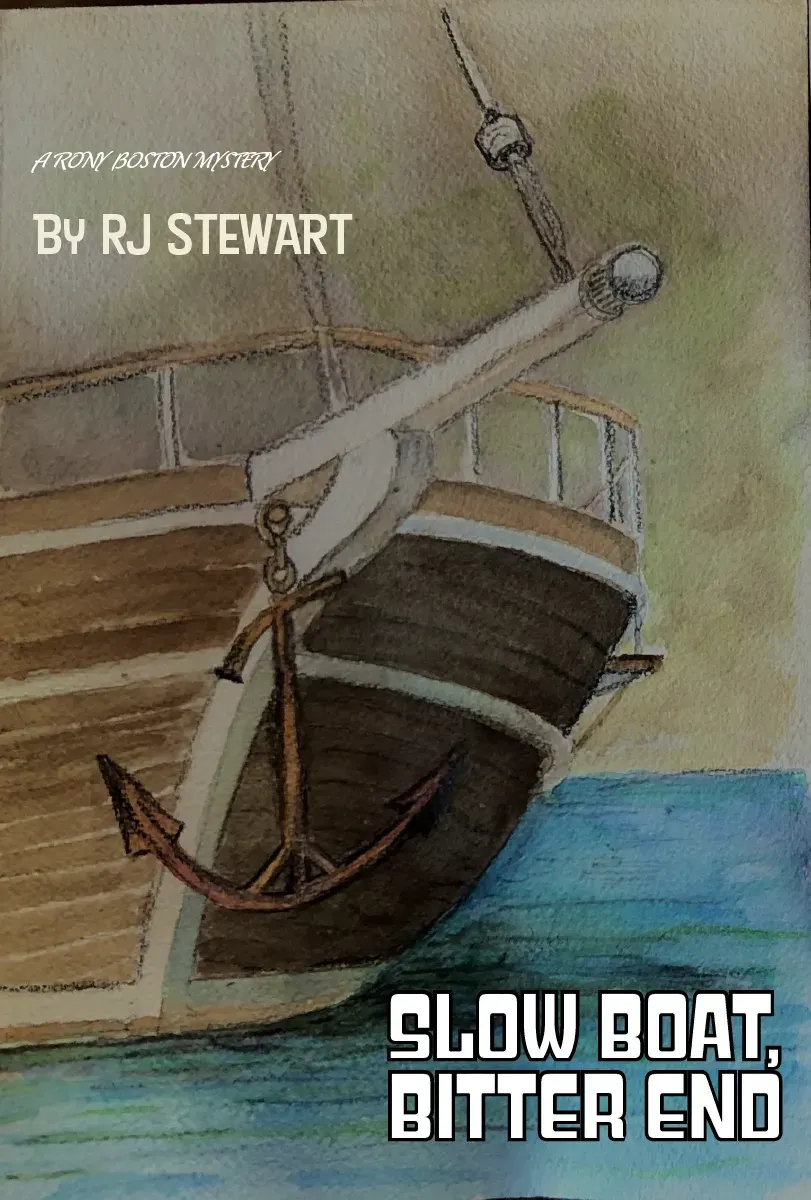
Water color by Caroline Hoyt
Working Title: Slow Boat, Bitter End
A Rony Boston Mystery
((This is a work of fiction. Names, characters, organizations, businesses, events, and incidents either are the product of the author’s imagination or are used fictitiously. Any resemblance to actual persons, living or dead, events, or locales is incidental. Artificial intelligence platforms are used occasionally for research but not for writing assistance.)
I HAD NOTICED Gungor’s absence earlier as we swilled our ouzo before dinner, but I soon forgot the matter, because, well, we know why. When Ruthie’s cry swizzled our drunken heads, we spontaneously fell from the affectation of social interaction and into panicked alarm. The steps from the deck to the lower dining area and navigation table provide for a single person but we threw ourselves onto the stairs like toothpaste squeezed from a tube. The hatch isn’t exactly long enough to accommodate a rapid descent, which means if you don’t duck your head, you conk it good, which I did.
Ruthie already was in Henry’s arms when I, holding my head, saw the rodent. It cowered, as confused and possibly as drunk as we were. Everyone knows that rats love ships, but it did not occur to me that one would show up at dinnertime on a luxury yacht. Damned thoughtless of the pesky critter. But there it was, an unexplained toppled bottle and a puddle of ouzo on the floor nearby.
Gungor suddenly appeared from the galley with a a knife the size of a scythe and began to swing at the unwelcome pest. Of course, the weapon was unsuited for this war between man and beast, and Gungor soon stopped, possibly aware that he’d be running up a horrific tab for damage to the teak and mahogany if he didn’t give peace a chance. The rodent took the opportunity to scurry up the stairs and onto the deck with all of us except Henry and Ruthie, who were still trembling by the chart table, in hot pursuit. Griselda was completely out of character, at least the character I had projected. She grabbed the bottle of ouzo, wielded it over her head, and chased the critter along the gunwale and onto the fore deck, her gorgeous gown stretched to the limit with her aggressive strides. With nowhere to go, the rat leapt onto the bowsprit, ran to the end of it, and dove overboard, legs, ears and long tail flailing as if waving goodbye to the lot of us. When we all caught up with Griselda, we shouted our congratulations, hugged and danced with her, and then at Vasil’s loud and happy urging hollered a saloon-a at the sea and its newest species.
Brilliant! Said Vasil
Hot diggity! said Neil.
Brava! said Tad.
You saved the day! said Abra.
And the ouzo!, said Judith, giggling into Abra’s neck.
Henry and Ruthie finally joined us as Barbara and Geoffrey did.
Henry pondered the crazed situation, and then said:
I am reminded of the time Odysseus encountered Circe…
What followed I can’t accurately reconstruct except to say that Henry launched into a soliloquy about the fabled enchantress whose skills included the ability to turn people into animals. Henry’s premise had something to do with the rat being sent there by the gods to remind us of the dangers of certain potions, which, in the context at hand, could be called ouzo. I recalled from somewhere that it has been debated as to which mind metamorphosed people have, the critter’s or their own, newly encapsulated and aware but denied speech. In Franz Kafka’s view the metamorphosed creature has the brains and senses of the original. I hoped the rat had the rat’s brain, but its interest in ouzo had me wondering. What if it was some goddess who grew irritated with one of us and in anger or spite turned the offender into a rat? Aha! This interpretation can only be explained by the effects of ouzo, but I was becoming more and more interested as Henry went on and on. The rat couldn’t have been any of our cohort of voyagers suddenly transformed, because we were all on deck drinking, lying and getting drunk. At the time, I wasn’t so sure about the crew members. As far as I knew the only one missing was the chamber maid and server, Aylin, who had her own fate unfold at the bow of the gulet. What if it were only her former body that remained after Circe made her into a rat? We properly disposed of the body, according to Islamic law, by sandwiching her between two planks and pushing her overboard. But with minimal imagination, Aylin could have undergone a kind of molting process whereby her former body, the one we discovered on the anchor, had been replaced by rat bones and rat flesh. There was no way to test this theory by examining the body because it was floating somewhere in the Aegean. Further, I was clearly under the influence, and I cannot tell you about the conclusions of this daydream, because I passed out.
I awakened and found myself in my comfortable bunk under the fore deck. How I got there was a mystery, but there was a pleasant odor in my room, not what I would expect from a hangover. I rolled out of bed, stumbled to the head, and began to piece together the evening’s events. When I returned, my watch glowed with the most despised time of all: 3:33 a.m. For years when I worked at the Tribune, I would wake precisely at 3:33 a.m. – uncanny, improbable, logic-defying, and enormously annoying. Now on this leisurely vacation, where I was to be relaxing and discovering myself, my watch told me that I was still me.
With that, I rolled into a sure-fire sleeping position and decided I would let slumber ease my troubled mind. And, as used to happen, my brain decided it was a perfect time not to sleep but to work. My crafty brain scrolled through the day’s events until it landed on Circe and the Rat and I knew sleep was losing out to dreamy analysis.
I told myself over and over: The rat dived to its death. It was not Aylin diving to her second death. It was just sea-faring vermin scared out its wits. But what about Aylin? She was impaled on the anchor point. She was buried in the sea. If a Greek god was responsible, it would be a delightful tale, but not probable. Could there be another explanation for her death? And why? What motive? Let’s see… it was Gungor who was there at the capstan trying to no avail to hoist her body back aboard; did Gungor know more about the events? Where was Gungor, our smiling host, at dinner? I decided it was a stupid time for detective work, and so I did another stupid thing; I dressed and went topside.
With my iPhone torch I inched my way quietly back to the capstan. In the dark, I directed the light to the capstan and slowly surveyed it. Until then, thanks to ouzo and other distractions, I was not aware of whether we were at anchor or not. But we were. I looked aft, port and starboard for some sign of the shoreline, but the sky was completely black. Where was that beautiful moon we had just a few hours ago? I couldn’t be sure how much of the anchor chain had been paid out to set anchor, but I could assume I was probably seeing more of the chain than I had seen when I was discovered by Vasil and his hostile-seeming body-language two days ago. I went to my knees and examined the chain as carefully as I could. I don’t know what I expected to find. Frankly, I was as curious about how the whole ingenious mechanism works as I was about the possibility of finding some explanation of how Aylin came to be impaled on it. I moved from the wildcat toward the hawse.
(I know; these terms are baffling. Well, to review what my iPhone and Wikipedia told me later … the “wildcat” is the machined circular wheel at the bottom of the capstan that when rotated by a crank or motor locks into the individual chain links and pulls the chain aboard. The “hawse” is the hole in the ship’s bow through which the anchor chain passes as it goes overboard. Boring, of course, unless you’ve tried your hand at sailing, as I had, or if you just like to know about stuff.)
As I moved forward, the only thing of interest was the rust that had accumulated on the chain links. Toward the hawse, about ten links in, was a single link painted bright red. What was that for, I wondered. I used my iPhone to take a picture of it for later reference. I was moving on toward the hawse on my knees when something deep blue in color caught my eye. At first, I thought it was just paint used to coat another link, but it was only a dot of blue. I put my light on it and discovered something evidently snagged on one of the links. It looked like polished rock. When I placed the light behind the object, I could see that it was translucent and of a deep azure color. At its center was another circular form, black as night. Around its edge was a baby-blue ring and a thinner snow-white ring. From a different perspective the thing resembled an eye.
I wanted to avoid disturbing anything, but I was too curious. I touched it. When it moved, I could see that it was snagged on the link by a small cord, also blue. The cord was looped through a hole in the stone or whatever it was. Maybe it was glass. Unfortunately, my handling dislodged it, and it fell onto the deck, bouncing a few times out of sight. I used the light again to search the open deck and then the wooden channel that guided the chain from the wildcat to the hawse. I was fortunate to find it again, because it had lodged in the channel beneath a link and was barely visible. I lifted it again, held the light to it, and knew exactly where I had seen it before.