On Friendship
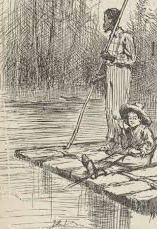
Huck and Jim; Lila and Lenù
In recent days the concept of friendship has been on my mind, most likely because I have lost people who were dear friends. The emotions stirring inside begged questions regarding the nature of friendship and what it means to me.
I have benefit of a long life, which is to say I’ve met a lot of people in the various communities in which I have lived and worked. I have made many friends, but there is but a small number of “true-blue” friends with whom I have shared the most intimate of ups and downs.
For me, there have been friends ranging from acquaintances to very close pals.
I even asked a very brief acquaintance to consider a deeper relationship — whimsically. Eartha Kitt, near the end of her life at the time, laughed at my marriage proposal which came after watching her perform at a Seattle jazz club. She laughed. I think she knew my “proposal” was a way of saying nicely done. I would say, too, the lightness of her reaction to my insouciance was reason enough to consider her a “friend,” although not in any conventional sense.
But after losing two friends within a few weeks, whimsy feels inappropriate. I need to know more about the deep feeling of loss that has taken hold. Part of the introspection, to be sure, has to do with my concern that I may not be as assertive as I should be in nurturing remaining friendships.
I looked in literature, at least the literature I could think of, where friendship is deeply bonding. Huckleberry Finn and Jim came to mind, as did the two life-long friends in Elena Ferrante’s novel My Brilliant Friend. Readers will certainly think of others from the movies or from their reading.
Much like my dear friend from high school, another dear friend from elementary school, and my dear friend from early adulthood, Ferrante’s characters Lila and Lenù grew up together and transitioned from childhood to maturity without losing their devotion to one another. That childhood period of time — let’s say from ages five to twenty — is short, perhaps but a fifth of a typical lifespan. But it is a period of enormous physical, emotional and intellectual change. In most cases, interests are different in childhood than in one’s teens and early twenties. Early childhood activities are far less fraught than jockeying for boyfriends and girlfriends, for example, but both periods often put raw emotion on embarrassing and regretful display.
Ferrante says she wrote her novel as fiction and not autobiography, and one wonders how the stories could be so revealing without being at least partly true. Both protagonists are intelligent, but their life circumstances result in different opportunities and choices. Lenù, who deems herself intellectually inferior, is able to pursue advanced education, while Lila remains in Neapolitan poverty. A sense of unfairness, if not guilt, develops in Lenù, and feelings of resentment bubble up in Lila. Nevertheless, each sustains the friendship when it would be understandable if emotions derailed it.
Ferrante’s nuanced portrayal of a complex relationship has earned her much respect as a writer. Other novelists have handled the idea differently, also with literary excellence. While friendship is easily romanticized, Ferrante includes the complex with the superficial.
With Huck and Jim, experiences deepen their frendship. Their differences are cast in 19th century norms of race, slavery and opportunity. Samuel Clemens, in his wry way, weaves a tale of a changing relationship that is at first what readers would have expected of a white boy harboring an escaped slave. Their “adventures” at times are deceptively comic, until the reader realizes the high stakes for both. As a slave on an adventure with a white boy, Jim’s possibility of “true-blue” friendship with Huck seems remote, but life leads each of them into adversity, and adventure deepens their love and care for each other.
What can be learned from these examples of friendship? With Lenù and Lila, a lot resonates. For example, there have been times with my high school friends that each of us seemed prepared to move on. At the same time, there were events of life-saving significance which were too important to be given short shrift. Which is to say, one might want to weigh the ups against the downs before moving on. Such stock-taking can be helpful in saving marriages, too, but that’s another story.
It would have been easy for Huck or Jim to just walk away, if for no other reason than to avoid complications. But the moments of fellowship, breaking bread, taking risks, sharing fear, and escaping from shared threats deepened their respect for one another. I wonder if men and women with combat experience are able to tell of trauma resulting in deep and enduring friendships.
As with Lenù and Lila, similar age, similar intellectual and musical interests, and physical activities such as football and mountain climbing played a role in sustaining my continued contact with my high school friend. It’s clear that as changes unfolded in my life, my selection of friends changed, too. Few friendships forged as a child last into maturity; certainly even fewer into old age. Some friends were forgotten without any defining resolution. And a couple lasted, and with extraordinary value and significance.
What was it with Huck and Jim? Most obviously, the social structure into which they were born presented barriers unlikely to be surmountable. And therein lies Clemens’s genius: By imagining something highly unlikely, he could use the “lies” of story telling to reveal truths about humanity and falsities of the institution of enslavement. His story is moving on a personal level and inspirational on a cultural level.
What ended these relationships? The friendship of Lenù and Lina does not end in a single, dramatic event. Rather, their friendship dissolves insidiously. Unresolved wounds, choices to separate, grief and blame, and disappointment in the other’s response to a difficult situation eventually take their toll.
With Huck and Jim, the relationship does not end. Clemens implies that their bonds had grown so strong that nothing could pull them apart.
In real life, one lesson is clear: To survive, friendship must be nurtured like a bonsai artist coddles a living plant. Take good care. Don’t let the sun go down on your anger, as Paul advised the Ephesians. If words can’t be found to heal a rift, search for a small action that can suggest willingness to work it out. There can be laughter. There can be forgiveness. And there can be the healing benefit of time.
If time remains.