On establishment
The poetry of the First Amendment
IS THERE SOMETHING in the human brain that wants others to be just like us? It seems all too common for one person or group to want to compel others to be like them, to believe like them, to dress like them, or just do what they say. Why is that?
Religious movements in particular sometimes engage in highly organized attempts to change the spiritual view of others. Among the most legendary in literature is Abner Hale, James A. Michener’s fictional zealot who set out to fix what he thought were the errant traditions and pagan beliefs of indigenous Hawaiians. Why?
Churches of all stripes seek converts, and no effort was more lasting or more military than the Crusades of the 11th, 12th and 13th centuries. What motivation was at work? Maybe it was religious zeal, promises of absolution and glory, or the desire for wealth and land that motivated aggression against others. 1 Was it then dominance at work?
Now rising in America are organized attempts to establish a religion. “Establishment” is specifically outlawed by the First Amendment, not because it’s “bad” but because the Founding Founders respected disparate consciences. So why would folks who present themselves as especially loyal patriots advocate for one established religion? And perhaps more to the point: Why is it not enough for them to be able to exercise their religion freely without imposing it on others?
The Founding Fathers wrestled with the concept. Some of their forebears came to America to escape religious persecution. But there were among them others whose conscience was less doctrinaire. In his book, Founding Faith: Providence, Politics, and the Birth of Religious Freedom in America, Steven Waldman points out that some weren’t “Christian” at all. 2 As a result, the Founders came up with these 45 words to ensure that different beliefs would be protected:
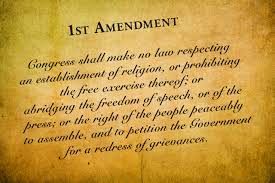
Congress shall make no law respecting an establishment of religion, or prohibiting the free exercise thereof; or abridging the freedom of speech, or of the press, or the right of the people peaceably to assemble, and to petition the Government for a redress of grievances.
It is James Madison who is largely credited with crafting the First Amendment, and its remarkable brevity is given near reverence by some American legal scholars. In his book, Madison’s Music: On Reading the First Amendment, Burt Neuborne argues that there is a deep structure in the language of the Bill of Rights that is distinctly poetic. Moreover, he argues, the document should be considered as a whole, like a poem, and not parsed as bits and pieces scattered about for isolated interpretation. 3
In fact, Neuborne says, as the document is disassembled and reduced like a dinner sauce, the overall concept of liberty is weakened. Deeper and more cohesive meaning resides in the whole more than in its dissected parts. His argument is directed principally at the Supreme Court justices who have the responsibility of making sense of the Bill of Rights and applying its principles to contemporary conflicts. Neuborne says they ought not to pick it apart so much as view it in its entirety.
There can be little doubt about what the Founders intended regarding establishment; they could not have been more direct. Influential and powerful people in the federal government today have distinctly different ideas, and they openly advocate for establishment of Christian nationalism. Some even think their faith must manifest against people whose ideas differ. Consider these statements of Pete Hegseth, the U.S. Secretary of Defense:
‘Separation of church and state’ is the main argument secularists use to deport God from every quarter of our country. But as many Americans no longer know, the phrase ‘separation of church and state’ does not appear in either the Declaration of Independence or the Constitution. It’s the leftist folklore that, after years of indoctrination, has become orthodoxy.
The Founders weren’t “secularists,” nor were their religious beliefs homogeneous. 4 They were aware of their denominational differences and keen to their trigger points. They witnessed religious persecution, especially toward Catholics and native peoples. If they thought a national religion was best for their baby democracy they would have codified it, but instead they wrote the First Amendment.
What Hegseth believes is of no harm to anyone until it enters others’ belief territory, which the Constitution protects. Hegseth even talks in terms of a modern “crusade” and mentions violence as a potential tool:
Using guns or swords to coerce others into a religious belief violates more than the First Amendment. But if the First Amendment remains the lawful guideline regarding establishment, Hegseth’s crusade will find in it no friend.
To return to the statement at the top of this post, what is it about the human desire to control others?
Researchers distinguish control from agency. On the one hand, people want to decide for themselves what they believe, and, within legal and social boundaries, they want to control where they go and what they do. Humans are “wired” to control their circumstances, and loss of autonomy often leads to depression, anxiety, or even suicide. 6
But the need to control others? What is the psychology behind that? Few want to be controlled, but some desire to control others.
Waldman’s book is especially enlightening regarding today’s cultural warfare, because it addresses some of the fallacies on both left and right. For example, the left mistakenly asserts, as Hegseth mentions, that there is a Constitutional mandate for separation of church and state. Waldman says, “Liberals can certainly argue for strict and pervasive separation, but cannot claim all the Founders as agreeing.” On the same page, he refutes a common conservative fallacy that, “… separation of church and state is a twentieth century invention of the courts . . . Not all Founders wanted rigorous separation, but a few rather important ones did, especially James Madison.”
The Nut Graf: Today’s often misguided cultural warfare has hardened political positions with little to no regard for the wonderful liberties established in the Bill of Rights and especially in the First Amendment. Where the Founders excelled is where today’s political leaders seem woefully unskilled. Although they differed in their beliefs, the Founders used their intellects to find 45 perfect words to protect both the right to exercise religion and to be protected from federal government establishment of it.
https://www.perplexity.ai/search/a6fccb54-e525-4562-ad25-e33d11ee7bb6 ↩
Waldman, S. (2009). Founding faith: How Our Founding Fathers Forged a Radical New Approach to Religious Liberty. Random House Trade Paperbacks. Page 72-73. ↩
Neuborne, B. (2011). Madison’s Music: On Reading the First Amendment. New Press, The. ↩
Waldman, S. (2009). Founding faith: How Our Founding Fathers Forged a Radical New Approach to Religious Liberty. Random House Trade Paperbacks ↩
Hegseth, P. (2021). American Crusade: Our Fight to Stay Free. ↩
Leotti, L. A., Iyengar, S. S., & Ochsner, K. N. (2010). Born to choose: the origins and value of the need for control. Trends in Cognitive Sciences, 14(10), 457–463. https://doi.org/10.1016/j.tics.2010.08.001 ↩