Creative juices
What gets the artist comfortable enough to create?
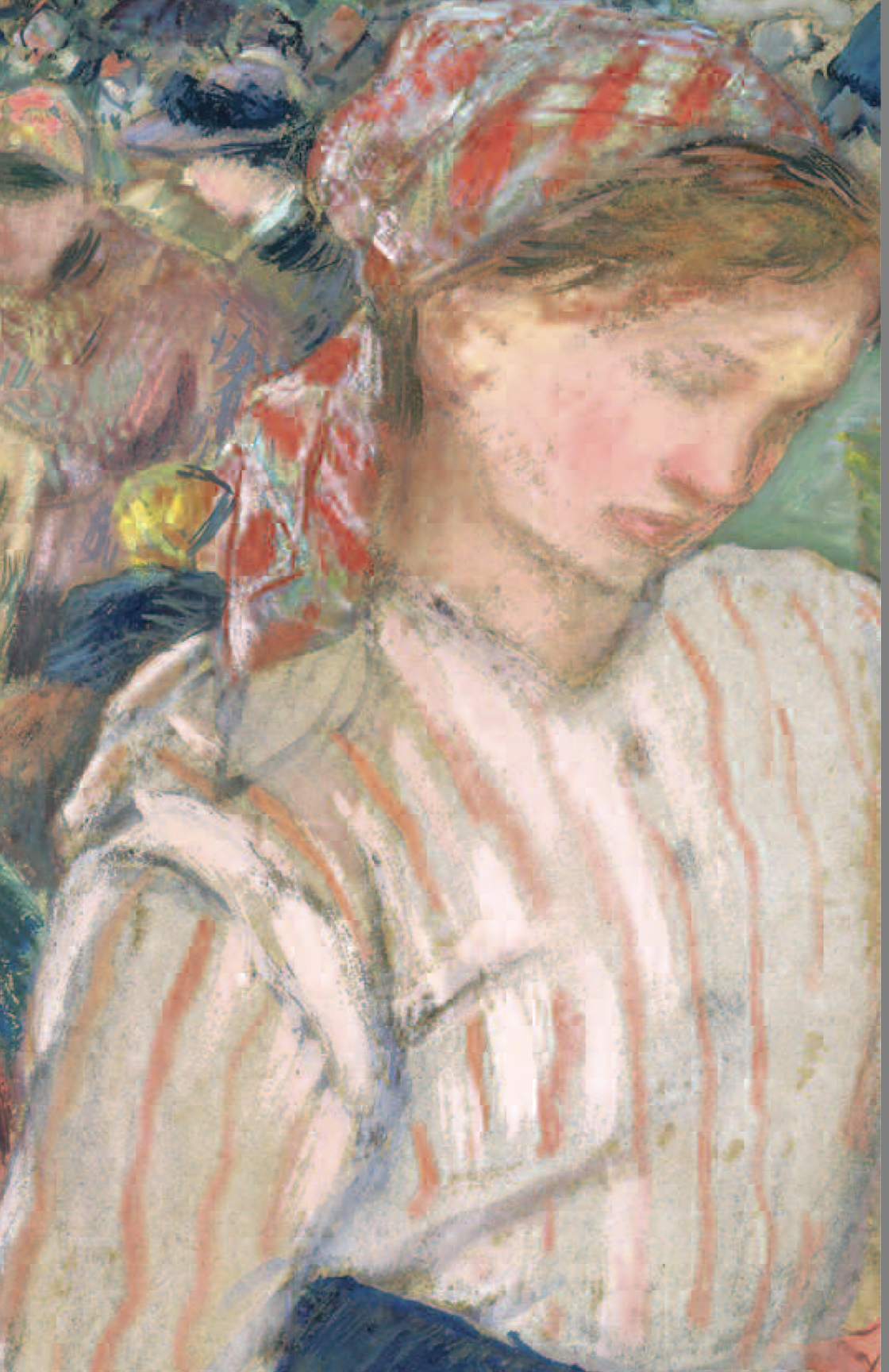
THE IMAGE ABOVE is detail from a painting by Camille Pissarro. He is sometimes called the father of impressionism, the very first person to strike out with what would become one of the most loved of painting styles.
But it wasn’t always so for Pissarro. His work cut a new path, and critics were not impressed. He liked the idea of painting the common person, not the pretentious poses of the ruling class. Just getting his paintings accepted into prestigious Salons of the day was nearly impossible. But he kept at it, and eventually established his own Salon.
By all accounts, Pissarro was a kindly gentleman, a painter who had room in his heart and in his eye for the creative spirits of others.
His work comes to mind after I visited an artists’ enclave near my home where several visual artists do their work. Each artist had a nook and the freedom to organize it as they wish, but all were situated in a single large, open room.
I noticed the “style” of each artist’s work and realized how different they were. Despite the “collective” of their chosen work environment, each pursued a unique style of art. One liked very low horizons and vast skies punctuated with realistic cloud formations. Another liked abstract shapes and colors. Another liked portraits and urban landscapes. One evidently had a science background and included mathematical expressions in the artwork. Another liked colored pencil expressed in exquisite detail.
I had just read one artist’s thought that visual art is not a performative practice, and I found myself agreeing.1 That is, until I visited this studio. Some may prefer working alone, but others feel comfort and inspiration when working, not as a group, but in a group. I wondered if those in this studio are of the variety that like to be removed from other environments so they can be “alone” in an environment focused on creativity.
Still, I wondered if the artists in the collective environment were sometimes critical, or worse, judgmental of each other’s work. I even asked, as subtly as I could, if they ever felt that way. It didn’t seem so. In fact, the three artists present indicated feelings of comfort and helpful, almost collaborative, commentary.
I left wanting to think more about this idea. What gets creative juices flowing, and what sustains them? What’s at work beneath emotions of jealousy and competition? What joy comes from community? And from solitude? If I were a visual artist, would I like a place to go and be among other artists, or would I prefer to work in solitude?
Later, my partner began to discuss the work and persona of Camille Pissarro. His work is her favorite, and she had visited an exhibit at our Denver Art Museum.2 In her enthusiasm, she mentioned that the critics didn’t give Pissarro much attention in his life, nor were they kind in their assessment of his unusual style. But he was not deterred. He liked his ideas and he continued to develop them.
When I looked into his background (using the amazing reference library called Perplexity), I learned that he was a nice guy. He was known for his kindness, welcoming attitude, and wisdom and his willingness to share his ideas and encourage his friends. As a result, he was a beloved mentor and stable figure within the Impressionist and Post-Impressionist movements.3 Consider:
Taking classes at the Académie Suisse in Paris, he met Monet and Cezanne, who shared his aversion for what they regarded as the hackneyed art of the Salon. In the 1860s, they would meet up regularly with fellow painters Renoir, Sisley and Manet, and writers such as Emile Zola, to debate art at the Café Guerbois.
An important school of aspiring artists was, in fact, finding its way and establishing mutual reassurance for their as-yet-unappreciated styles in the process. They could be found working side by side, as my friends do at their studio. In the evenings, they would gather to eat, drink, and discuss the art world with Emile Zola, a writer with profound ideas about naturalism, a belief that writing should be real, grand, and simple, much like Pissarro’s paintings. 5
But what about the psychology of the two approaches to creativity, collective, on the one hand, and solitary on the other? Michelangelo, for example, lay on his back for days to paint the frescoes on the ceiling of the Sistine Chapel. What about the stultifying effect of fear of failure? Of judgment? Of inferiority? Could a social environment produce a subtle competitive environment that becomes unhealthy?
As a writer, I work in solitude. I place earphones on my head and turn on music, often the quartets of Béla Bartók, which are hardly soothing. I seldom ask for a critique of my writing before I publish it, although I frequently ask for ideas and perspectives of friends when I am mulling over an idea. I use the “research library” of the great artificial intelligence platforms. Does all this suggest that I don’t, in fact, work in solitude?
Of course, the answers are personal. What works for me is fine, but it may not be what works for others. There really is no doubt in my mind that I would benefit from a more social approach to my writing, if for no other reason than to help me spot and fix grammatical, spelling, syntactical, and usage errors before they are published. But I usually don’t.
What remains of this meditation? Only this: Human creativity is a wonder. The expression people make with their ideas, visions, plays, essays, stories, emotions and aspirations is immense. The results are sometimes timeless, sometimes quickly forgotten. Sometimes artfully expressed ideas are so thought provoking that they change the course of history.
Not often enough is pause taken to consider the importance of art and of artists. However they arrive at their moments of creativity, we can be thankful that they do. We are often moved emotionally by art, in ways more powerful than we know.
Visit HERE to see some of Pissarro’s art and the comments of one writer who has considered his work.
https://www.smithsonianmag.com/smart-news/the-paintings-of-camille-pissarro-the-first-impressionist-are-finally-getting-the-attention-they-deserve-180987697/ ↩
https://dooleyyoung.medium.com/resilient-and-calm-notes-on-camille-pissarro-78bbb7545dcf ↩
https://www.christies.com/en/stories/collecting-guide-camille-pissarro-02cf6e53a4cd4a369aec02a79831a6bf?utm_source=perplexity ↩