An Affair to Remember
Dreyfus and the warrior mentality
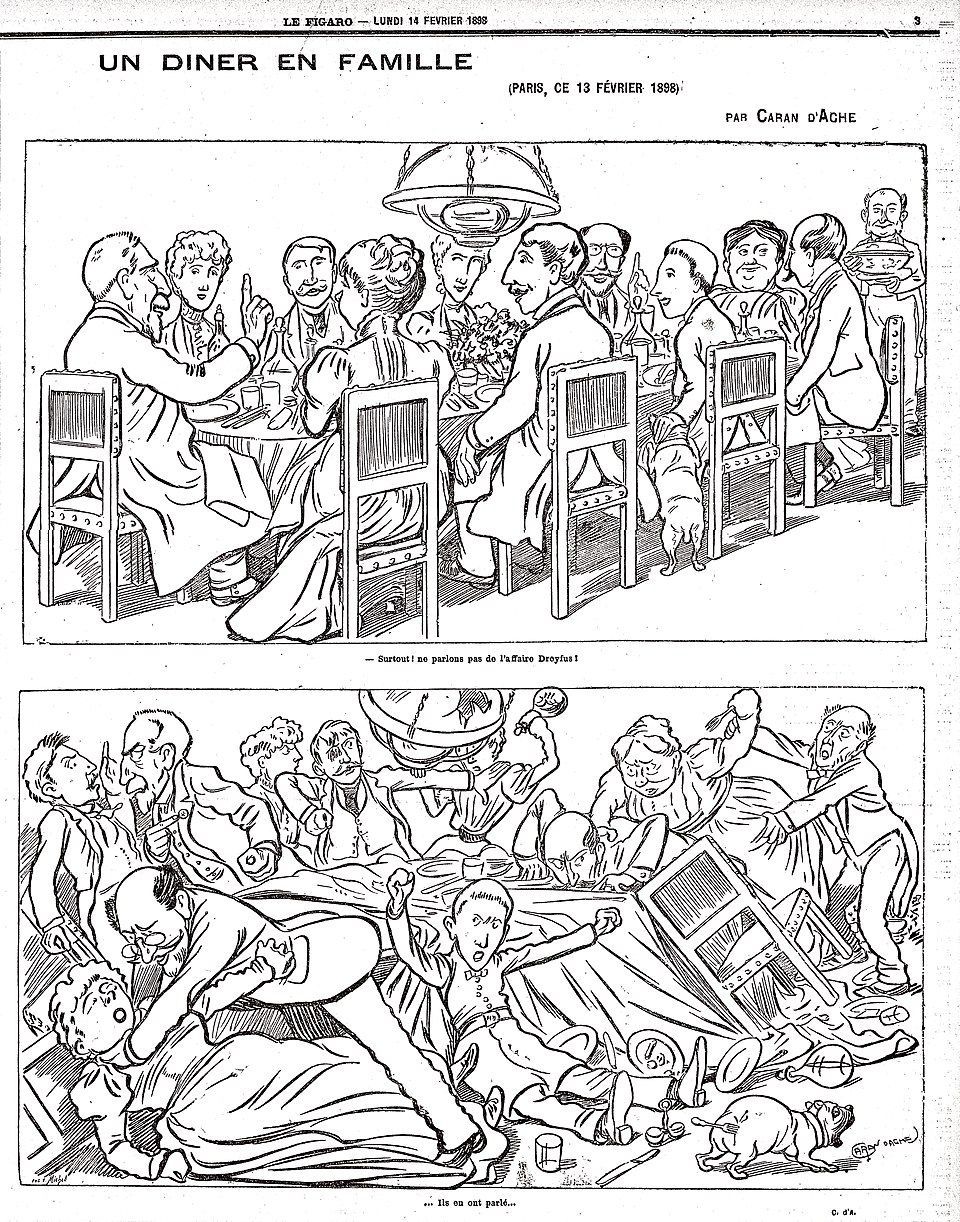
Drawing of “a family supper” by Caran d’Ache in le Figaro on February 14, 1898. The drawing depicts the divisions in French society during the Dreyfus Affair. At the top, somebody says “Above all, let us not discuss the Dreyfus Affair!”. At the bottom, the whole family is fighting, and the caption says “They have discussed it”.
IF IT SEEMS POLITICS has hopelessly divided Americans, consider the atmosphere in France in the late 1800s. The ostensible issues then might at first glance seem irrelevant to the present time, but if history can be instructive, maybe it’s time for a closer look.
What divided French politics then began with humiliation of the French army after losing the Franco Prussian War with Germany in 1871. The war resulted in the establishment of German Empire and the end of Second Republic of Napoleon III. Germans’ faith in Prussian militarism was solidified, and military values such as duty, honor, and sacrifice permeated much of everyday life for years afterward.1
Meanwhile France, defeated disastrously at the Battle of Sedan, lost about 17,000 soldiers, and more than a hundred thousand were taken prisoner. Decimated, the French military had little more than hope of re-establishing its military. Under constant threat from the revitalized Germans to the north and the threat of a German influence in Spain to the South, the French rushed to fortify defenses on its northeastern border, to build infrastructure suited to a defensive style of warfare, and to focus on new technologies in weaponry. In effect, France quickly abandoned adventurous Napoleonic military style in favor of a defensive strategy.2
By the end of the 1800s France also had become openly and nearly institutionally anti-Semitic. For Alfred Dreyfus, a proud lieutenant-colonel in the French military, the hatred of Jews ruined him temporarily and nearly completely. The Dreyfus affair continued for more than a dozen years, with deep divisions of opinion on both sides. Anti-Semitism was unquestionably part of the popular opinion against him.
Accused, falsely, of being a traitor for passing weaponry secrets to Germans, Dreyfus was court-martialed and then humiliated by his fellow soldiers in a public ceremony at which his sword was broken and his insignia ripped from his uniform. A crowd yelled anti-Semitic slurs.
The “Affaire” was hugely public. But gradually the truth came to light. Dreyfus was innocent, and another officer, Ferdinand Esterhazy, was the perpetrator. But Dreyfus was an easy target because of widespread hatred of Jews. Military authorities were aware of his innocence but chose to cover up the affair and leave him imprisoned rather than to imperil their insecure reputation. 3
Famed writer Emile Zola passionately objected. With an essay published in the left-leaning newspaper L’Aurore, Zola wrote an open letter to French president Félix Faure. Zola’s letter began with a huge headline saying simply, “I accuse…!”
Diplomatically beginning with flattery to the president, Zola wrote, “your star which, until now, has shone so brightly, risks being dimmed by the most shameful and indelible of stains.4 He went on to detail:
Eventually, justice prevailed and Dreyfus was exonerated. Even so, the anti-Semitic sentiment in France continued. Dreyfus was attending a burial service for Zola on June 4, 1908, when Louis Gregori, a journalist and outspoken anti-Semite, attempted to assassinate him. He continued to insist that both Zola and Dreyfus were traitors. Luckily Dreyfus escaped with only a minor injury to his hand. Oddly, but perhaps not surprisingly, Gregori was acquitted in a rushed trial. 6
The events remind of the anti-Semitism that persists in Europe and in America today. Just this last summer a Jewish woman was killed and her husband badly hurt by a man who attacked them at a public event where people gathered peacefully to call for the release of Jewish hostages still held in Gaza by Hamas terrorists.
Substacker Timothy Snyder, an expert on the Holocaust, has argued that the administration’s attack on some U.S. universities has anti-Semitism at its foundation. 7 And other ethnic and racial groups have been horribly slurred by the president and his staffers. Ilhan Omar, the congress woman representing Minnesota’s Fifth Congressional District, was subject to the president’s recent rant. She is a naturalized American of Somalian descent, and has a record of working with Jewish members of Congress. The president called her “garbage.” She’s not alone; he has branded all people who have emigrated from Somalia as “garbage.” 8
If anything could be worse, it might be the current military leadership of Pete Hegseth. A man of comic-book ideas about masculine strength, he advocates renaming the Department of Defense the Department of War. Now he is under investigation for committing war crimes. However that pans out, it puts into perspective his outrageous advocacy of court-martialing Arizona Democrat Mark Kelly for reminding military personnel they must not follow orders considered illegal under Uniform Code of Military Justice. Like the French military, Hegseth insists on unquestioning loyalty.
What is worth remembering is the peril of absolute loyalty coupled with hatred of certain ethnic or racial groups. Such narrow ideas resulted in a wrongful prosecution of a Jewish officer in the French army more than a century ago. If Hegseth and the president have their way, Mark Kelly, who served in the military with distinction, will be tried as a traitor because he reminded soldiers and generals of their legal obligation to question and disobey illegal military orders. 9 Also troubling is what will happen in the upper echelon of our military if the facts point to illegal orders given in the Caribbean. Will truth out, or will the can’t-be-wrong leaders lie and coverup? Will a modern Emile Zola rise to accuse, or will the administration succeed in silencing all opposition? Hegseth already has required the Pentagon press corps to pledge allegiance to his narrative. The New York Times has countered with a lawsuit accusing the Pentagon of unconstitutional policies. 10
https://engelsbergideas.com/notebook/how-france-overcame-defeat-in-the-franco-prussian-war/ ↩
Jean-Denis Bredin, The Affair The Case of Alfred Dreyfus, (New York: G.Braziller, 1986) ↩
https://jean-max-guieu.facultysite.georgetown.edu/other-interests/english-translation-of-emile-zolas-jaccuse ↩
https://jean-max-guieu.facultysite.georgetown.edu/other-interests/english-translation-of-emile-zolas-jaccuse ↩
https://farkash-gallery.com/the-attempted-assassination-of-alfred-dreyfus-rare-original-chicago-american-issue-1908/#:~:text=Gregori%20declared%20his%20aim%20to%20prevent%20the,(Gregori%20was%20acquitted%20in%20a%20rushed%20trial). ↩
- "Antisemitism" and Antisemitism"And when Haman saw that Mordecai bowed not, nor did him reverence, then was Haman full of wrath." Esther 3:5

https://www.nbcnews.com/politics/donald-trump/trump-calls-ilhan-omar-garbage-somalis-go-back-came-from-rcna247041 ↩
https://www.militarydefense.com/military-personnel-must-know-the-limits-of-lawful-orders/ ↩
https://www.nytimes.com/2025/12/04/business/media/new-york-times-pentagon-lawsuit.html?smid=nytcore-ios-share&referringSource=articleShare ↩