When one thing explains another
Or, how metaphors enrich understanding
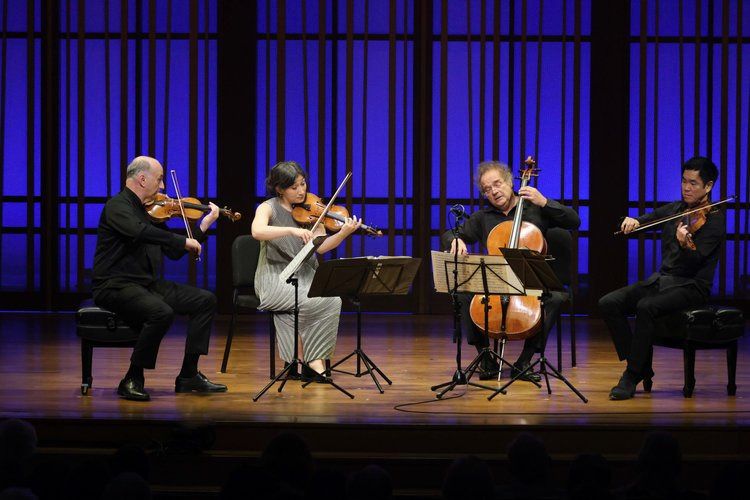
Photo Credit: Ken Jacques Photography
Recently at a performance of the great Takács Quartet, the first violinist explained something remarkable. Introducing a piece written for the quartet by Stephen Hough, Ed Dusinberre said the following. Take a look, and then let’s drill down.
One of the things we like about (the piece) is the way it moves between public and private spheres, and encourages us to think about how notions of public and private play out in our lives, for example whenever we perform for you.
I had been thinking earlier in the day about metaphors and how the human mind benefits from understanding one thing by comparing it to, or even calling it, something entirely different. This is an ancient “trick.” Writers and speakers have long used metaphors and similes to better explain an idea. Scientists, too, use the technique. Even “thought experiments” can be explained as picturing a concept in familiar terms and then mentally extrapolating possible scientific explanations.2
Mr. Dusinberre was speaking to an audience which regularly attends the quartet’s performances. Home base for the quartet is the University of Colorado’s College of Music in Boulder, so those who live in the region, if they are fortunate enough to get tickets, are blessed with world-class music on a regular basis.
His allusion to the process of listening, added to the often-felt need to discuss the experience, suggested to me the challenge writers and speakers face when trying to communicate a rich thought or a sharp emotion. Poets probably struggle most intensely with the challenge, but essayists and novelists do, too. 3 As Mr. Dusinberre suggests, the conversations at intermission in the lobby might similarly challenge listeners. I overheard one person say the performance of Hough’s quartet that day “was interesting.” That it was, but the speaker failed to paint a clear picture of what was interesting to him.
The composition alludes to a specific time and place, plus imagined emotions, colors, and tones. The composer perhaps started with abstract ideas about time and place, and then put his ideas into musical form. We listeners know from the title that he meant to suggest six encounters, and by using the French language, we can assume the place is France. But we need the program notes or some other source to learn who is having the encounters. Then we learn from the names of the six movements that he means to suggest specific places: the boulevard, the park, the hotel, the theater, the church, and the market.
The program notes, written by Marc Shulgold, quotes the composer himself:
“Seemingly enjoying himself in composing this bubbly, free-flowing music, Hough appears to have had as much fun writing extended program notes. In describing each movement, he relies on such colorful phrases as ‘... the central section warming the trope like vermouth around a bitter olive’ (Au parc), or ‘A spiccatissimo (very distinct) skeleton of motive dances in a recurring harmonic sequence, decorated with each repetition in more and more lurid colours, smeared with lipstick glissandos (slides)’ (Au théâtre).”
“Warming the trope like vermouth around a bitter olive?”
“Smeared with lipstick glissandos?”
Wow! How could anyone in the lobby do better than that?
But more to my point is that in explaining his composition with words, Hough helps listeners understand him, his musical imagination and his sense of humor. This all may seem obvious, but the process is remarkable. I cannot be sure how it all happens but I can imagine that:
Informed by conversation with the quartet, Hough sits with blank musical score paper and begins to sketch ideas. He focuses on six composers (Poulenc, Honegger, Milhaud, Auric, Durey and Tailleferre) who famously gravitated to Paris in the 1920s. He reads about them, imagines interactions they might have had, wonders how life there and at that time might have influenced their compositions, and fits his musical sketches together.
He conceives the musical material in four voices (two violins, a cello, and a viola) thinks about it, maybe shapes it differently, re-examines the structure and edits, and eventually is satisfied with his commissioned composition called “String Quartet No. 1 ‘Les Six Rencontres (meetings).’ ”
He sends (I’m continuing to imagine this) the score to the Takács musicians and asks for feedback. The quartet members review what’s written for their part, along with what’s written for their colleagues and maybe or maybe not provide feedback to Hough.
Revisions occur and then the ball (metaphorically speaking) is returned by the composer to the court of the famed quartet.
More rehearsals happen, and the world premiere occurs in a live performance in 2021 at Segerstrom Center for the Arts at Costa Mesa, California. 4
There is no way to know what comments were made in the lobby after the performance in Costa Mesa. “Interesting” might have been among them. But to get to the possible audience reactions, it’s noteworthy to back up and recap other “steps” (again imagined):
After receiving the score, each (I’m going to say ‘brilliant’) Takács musician begins to play their part. Some passages may be easy, and some may require extensive practice.
They assemble to rehearse for the first time. They exchange comments and ideas, play it again, repeat, repeat, repeat, etc., until they feel ready to perform live. This step is important, because it’s the first time a musical “conversation” has taken place between the musicians.
Then, they walk onto the stage, introduce the commissioned piece, and play it live. This is the first time they have enjoyed the music with an audience. Musicians, as Mr. Dusinberre mentions in his introductory remarks above, are inspired by a “collective quality of listening in the hall.”
I suspect that for some listeners the music will precisely suggest the boulevard, the park, the hotel, the theater, the church, and the market, but for others the music may evoke other images or perhaps none at all. The program notes combine with the music to give listeners a more complete picture. But even more might be revealed for those who attempt to find words to describe the listening experience after hearing it. For some this will be easy, and for others quite difficult, such as for the one listener who found the experience merely interesting.
We often resort to superlatives when at a loss for more accurate descriptors, as I did when I wrote “wow” above to react to Mr. Hough’s simile and metaphor to describe his work. For me, the simile, “like vermouth around a bitter olive,” was deliciously precise and cleverly humorous.
A friend of mine, Steinway Artist Hsing-ay Hsu,5 has helped me understand the listening process through her program called Conscious Listening™. From her, I have learned to notice such things as whether notes are rising or falling, how the physical features, such as a minor key, texture, or harmonic pacing, might help suggest a certain emotion and mood, and so on. Her tips include listening for humor, too, which would be helpful in the Hough composition as well as in his whimsical program notes.
Equipped with improved listening skills, I still am left with the challenge of responding in the lobby to a friend who asks, “what did you think?” For that I am taking instruction from other writers, thinking about the use of metaphors and similes, and hoping to enrich my life and my relationships by better expressing myself.
But for full disclosure, I will now confess that the person who used the term “interesting” was me. From now on, I will try to find some equivalent to “warming the trope like vermouth around a bitter olive.” In the meantime …
Wow!
The complete program in PDF format is linked below. It will be necessary to scroll down to page 17 to reach the program notes: https://connector.cupresents.org//files/productions/cupresents/1707507230/TAK25_250112_web.pdf ↩
https://en.wikipedia.org/wiki/Einstein's_thought_experiments ↩
For a deeper dive see: The Finest Writing is Poetic ↩
https://www.scfta.org/shows-events/calendar?range%5BPerformanceDates%5D=1735743600000%3A1738422000000 ↩