What we tell ourselves
Are we in the age of falsehood?
DOES IT SEEM that we live in an age of falsehood? Is lying more prevalent today than it has been in previous times? Or are we simply more aware of falsehood, thanks to the many forms of media that we have?
My suspicion is that we are more commonly using falsehoods than we did a few decades ago. We seem even to think that deception is a skill that is allowable, even admirable if it can advance one’s fame or fortune.
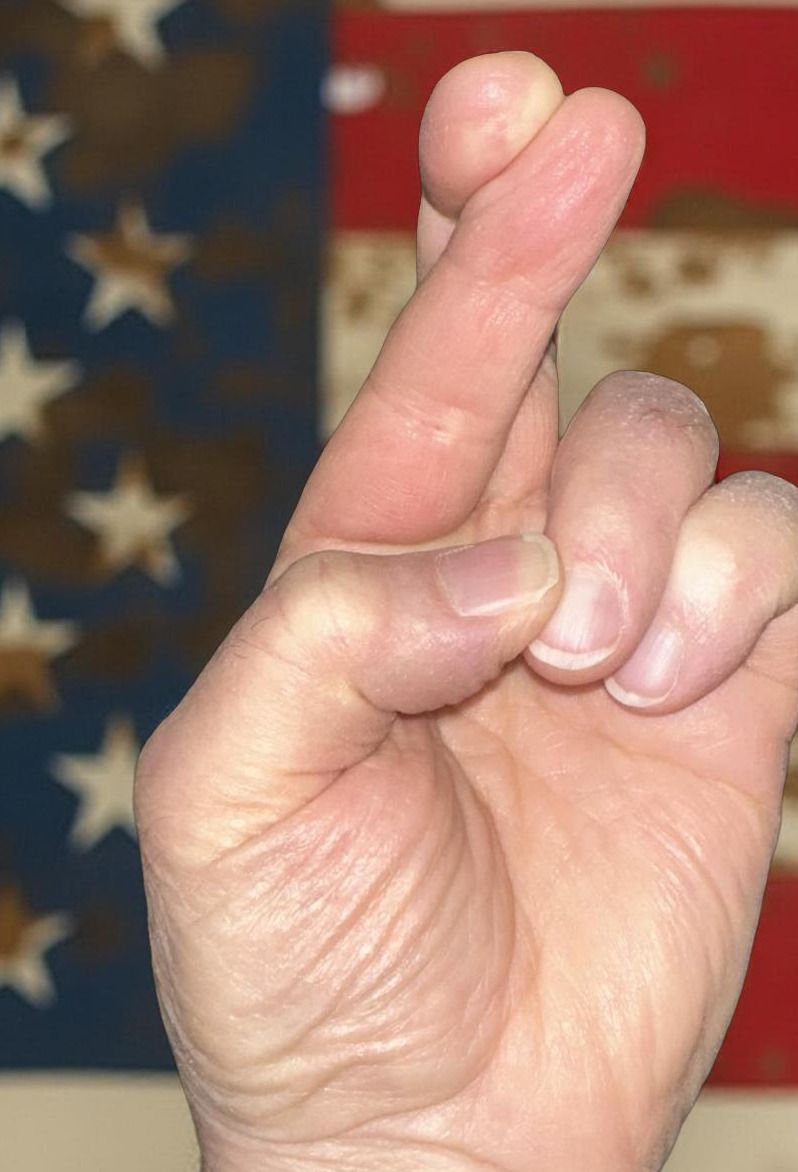
The proliferation of artificial intelligence is especially useful to liars. With a few prompts, technology can be used to generate fake images so realistic that viewers are easily deceived. The photo above is an example. That’s my left hand, a selfie that an AI platform placed before an American flag at my prompt to suggest that Americans are in an age of falsity. (But it’s a nice hand, for an 80-year-old guy!).
Oh wait … that last statement has something to do with this post, doesn’t it? I am telling myself that I have a lovely left hand. Is this merely vanity, or is it self-delusion? I could paste my mug up there and then brag that I look great, just as I did when I was 22 (which was debatable then, too). That would be a lie, and it would be laughable — or perhaps worrisome that I might be showing signs of dementia. With AI, I could even place hair on my bald head and trim my sagging physique. I could then convince myself with untruths that I’m a rare guy with perpetual youth!
As Dostoevsky suggests, self-deceit is both common and potentially hurtful. Psychologists, psychiatrists, dentists, and doctors are well aware that their patients lie. Most people in therapy lie, and the prevalence of lying clients poses challenges for those trying to help them. 1 Common answers on admittance forms for annual visits with the doctor are often lies, and doctors know it. 2
Why do people lie? With politics, especially in a democracy where the idea is to self-govern, lying is an example of collective self-deceit. Yet politics is replete with liars, and it’s not just the politically ambitious who lie. Their followers do as well. The most well-known liar these days may well be the current president. Fact checkers have documented that he lies at an astonishing rate. By one reckoning the president lied more than 35 times a day near the end of his first term; he seemed more at ease with lies than with truth. 3 But mention this to a cultist follower of the president and you’re likely to hear a passionate defense of his falsehoods — more lies, in other words.
Despite his lying, he has an amazingly loyal “base” of followers. Would other presidents have been so successful with lies? It’s doubtful, even though the current president certainly isn’t unique in telling lies. Consider, for example, the untruths told to Americans during the Vietnam war. 4
With mental and physical health, lying to a practitioner can have deleterious outcomes. Deceiving others has moral and practical implications, but self-deception can be hurtful to one’s mental and physical health. “Be careful about the stories you tell yourself,” is a common admonition because with mental health repeated lies can become operable truths. People who tell themselves they are worthless, for example, can fantasize at first and then act on suicidal thoughts.
Adopting an opposite narrative, that one is fantastic or the greatest, is likewise unwise. The power of positive thinking, introduced in popular form by Normal Vincent Peale in the 1950s, has been cited as beneficial for its capacity to create optimism. However, taken to an extreme the practice becomes a kind of self-hypnosis that is little more than fantasy. Optimism is motivational, but denial is unrealistic. It’s better to deal with life in a proactive way than to pretend all is well when it isn’t.
Today’s rampant anxiety with current events presents a Hamlet-esque conundrum:
To be, or not to be: that is the question:
Whether ‘tis nobler in the mind to suffer
The slings and arrows of outrageous fortune,
Or to take arms against a sea of troubles,
And by opposing end them?
These days many people elect to turn the news off, or at least tone it down, to avoid the toll of worry over things beyond our control. At the same time, the privilege of self-government depends on an informed electorate. Tuning out is one way of avoiding the din, but tuning in is another. Staying informed, checking facts, avoiding group thinking, and ignoring the intimidation of bullies who would silence us are essential daily disciplines.
Much is written about truth. Like the fiction of Dostoevsky, writers around the world have put into poetry and fiction profound ideas about truth as well as the perils of lies and self-deception. Perhaps truth is most impactful when spoken to powerful men and women. In his last speech before his assassination in 1963, John F. Kennedy paid tribute to the deceased poet Robert Frost by saying:
Most helpful is to boldly adopt Dostoevsky’s advice (offered, by the way, in his work of fiction, The Brothers Karamazov) to “watch over your own deceitfulness and look into it every hour, every minute.” Yes, others can lie to us, trick us, con us, scam us, phish us and so on, but the biggest con of all is our own. The good news is that we are the captains of our own ships, capable of changing speed or direction whenever we want.
https://societyforpsychotherapy.org/therapist-dishonesty-and-its-association-with-levels-of-clinical-experience/ ↩
https://www.advisory.com/daily-briefing/2018/12/10/lying-patients ↩
https://www.washingtonpost.com/politics/2024/11/06/what-ive-learned-9-years-fact-checking-donald-trump/ ↩
https://www.cato.org/commentary/five-decades-after-pentagon-papers-presidential-lies-foolish-forecasts# ↩