The Artist and Critic
How a snarky critic came to view an important painting
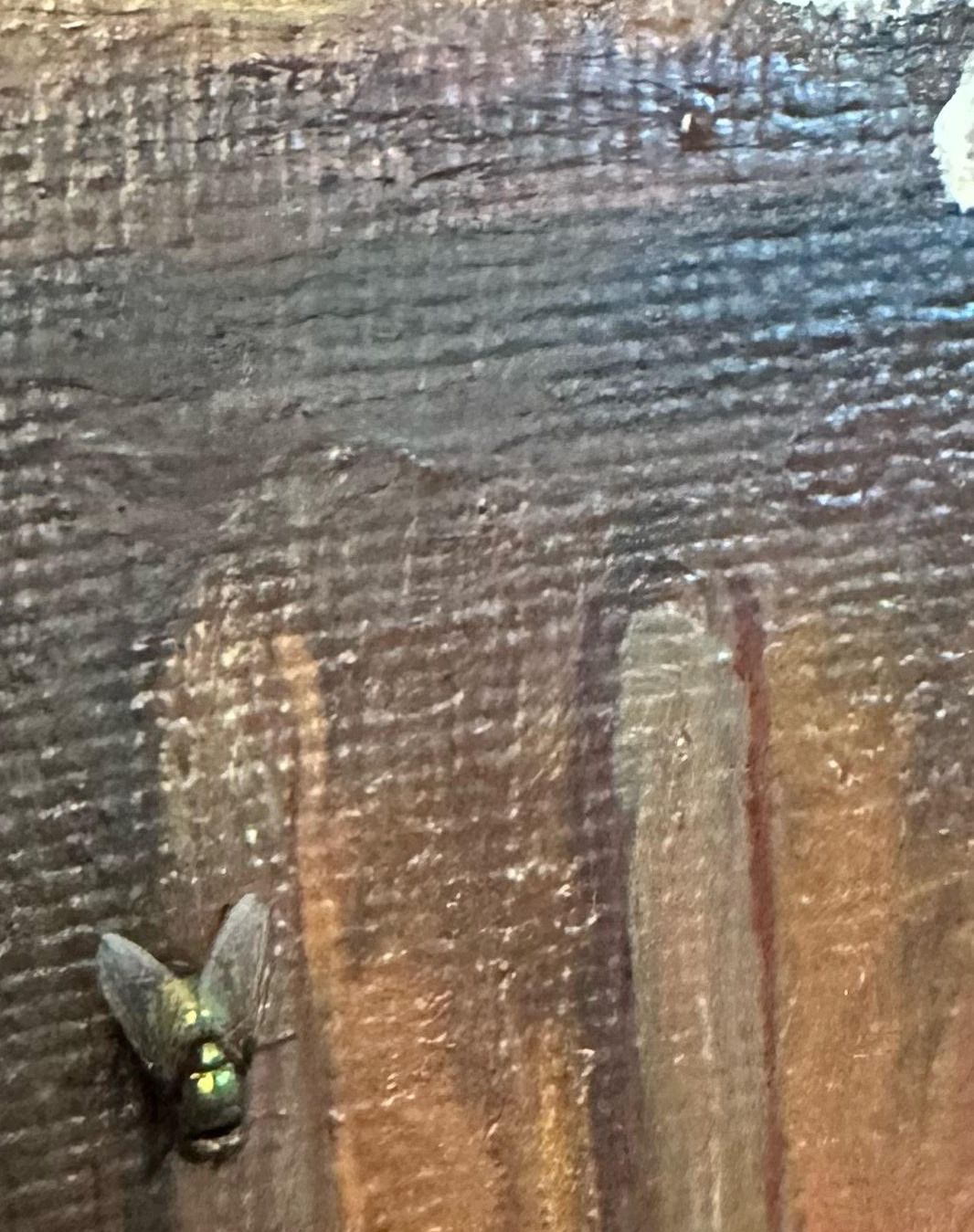
Photo by RJ Stewart
Art critic Vasil S. wrote in the Paris publication Les Arts that he’d love to have been a fly on the wall while Gudrin painted his Fireworks at Dawn. Vasil S. may have expected a bright sunrise, a sky of gold, magenta, azure, whatever. Gudrin had a different image in mind, and Vasil didn’t approve. With his typewriter, he made his opinion known.
“I would love to have been a fly on the wall, watching with a thousand eyes as Gudrin threw paint at the sensibilities of art lovers everywhere.”
He was proud of his phrasing. He wasn’t certain if a fly had ten or ten thousand eyes, but it didn’t matter. He was sure the idea would be clear. His readers would appreciate his elevated understanding of technique and, most importantly, taste. He regarded his reviews as quite significant, because they had been welcomed in publications in Europe, the United States, and occasionally in the Latin Americas. He had studied at a fine university in England, learning from the best professors. Even as a student, he had been recognized for his erudite understanding of the work of artists from Da Vinci to Francis Bacon. As he gained confidence in the world of art criticism, he found a humor that editors thought appealing. Laughing at an artist or at his or her pretense was somehow good for readership.
One reader wrote that Vasil’s writing brought “so much depth to my life” and so on. Another said she “laughed out loud” when reading about the sloppiness of a Scottish artist who “seemed to have confused his palette with his plate of pluck.”
Vasil S. didn’t know much about Gudrin’s background or that he had gone to Spain as a sixteen-year-old prodigy and studied with a fine teacher who grounded him in the style of El Greco. From him, Gudrin learned about Mannerists who saw purpose not only in imitating nature, but in exploring the underlying psychological aspects of an artist’s selection and expression of it. This idea led Gudrin to a dark palette and the El Greco technique of elongation.
As he explored these ideas, Gudrin also was drawn to Greek mythology, especially the goddess Circe. He read widely and eventually was drawn to the library of the Monastery of San Lorenzo de El Escorial, founded in the 16th Century by Phillip II, whose varied interests included Greek mythology. Phillip’s collection included exceedingly rare Greek and Egyptian manuscripts, one of which Gudrin discovered one November afternoon as he searched the antiquities section of the library. There he discovered Circe’s own description of her celebrated method of turning humans into animals. She had, for example, turned the crew of Odysseus’ ship into swine partly because they didn’t behave well as guests on her island. Gudrin was amazed that this work had never before been discovered, and while astonished with its clarity in the preparation of certain herbs and potions, Gudrin had not put this knowledge to work until he read Vasil S.’s review insulting his Fireworks.
“Bad behavior indeed, Mr. Vasil S.,” he said.
The rest really is simple. In addition to transforming Vasil S. into a house fly, Gudrin ordered him to rest upside down on an especially dark corner of Fireworks. Scholars have debated whether such transformed creatures have the mind of the original person or the mind of the creature into which they have been transformed. Gudrin knew the answer, because he read it in the undiscovered manuscript. Circe had the choice, and so did he. He settled on giving the transformed creature Vasil S.’s own mind, which Gudrin considered to be about equal to that of a fly.
One afternoon Gudrin’s housemaid was cleaning as she usually did on Mondays, when she noticed the fly on Gudrin’s painting. She was about to smash it with a swatter when Gudrin intervened.
“Dear Madam, it is not appropriate to kill the poor creature. It may have had a very long journey and merely needs to rest.”
“But sir, it is only a fly.”
“You can say that, but you do not know everything because you are only a creature of the Divine. Let’s let this poor thing live, or if you choose, we can collect it and place it in a jar.”
“Oh dear,” she said. “I don’t think it would be happy confined like that.”
“You see, Madam, you do have feelings for this annoying creature, and your feelings have spared its life.”
Gudrin lived to a very old age, long enough to have his work appreciated far and wide, even displayed in the Louvre. He kept Fireworks for himself and often referred to it when he was working. It is not known if Vasil S. eventually learned to view Fireworks more favorably after studying it so long and so closely. At least he wrote no more reviews on the subject.