Pathways
The brain is ready to incorporate learning
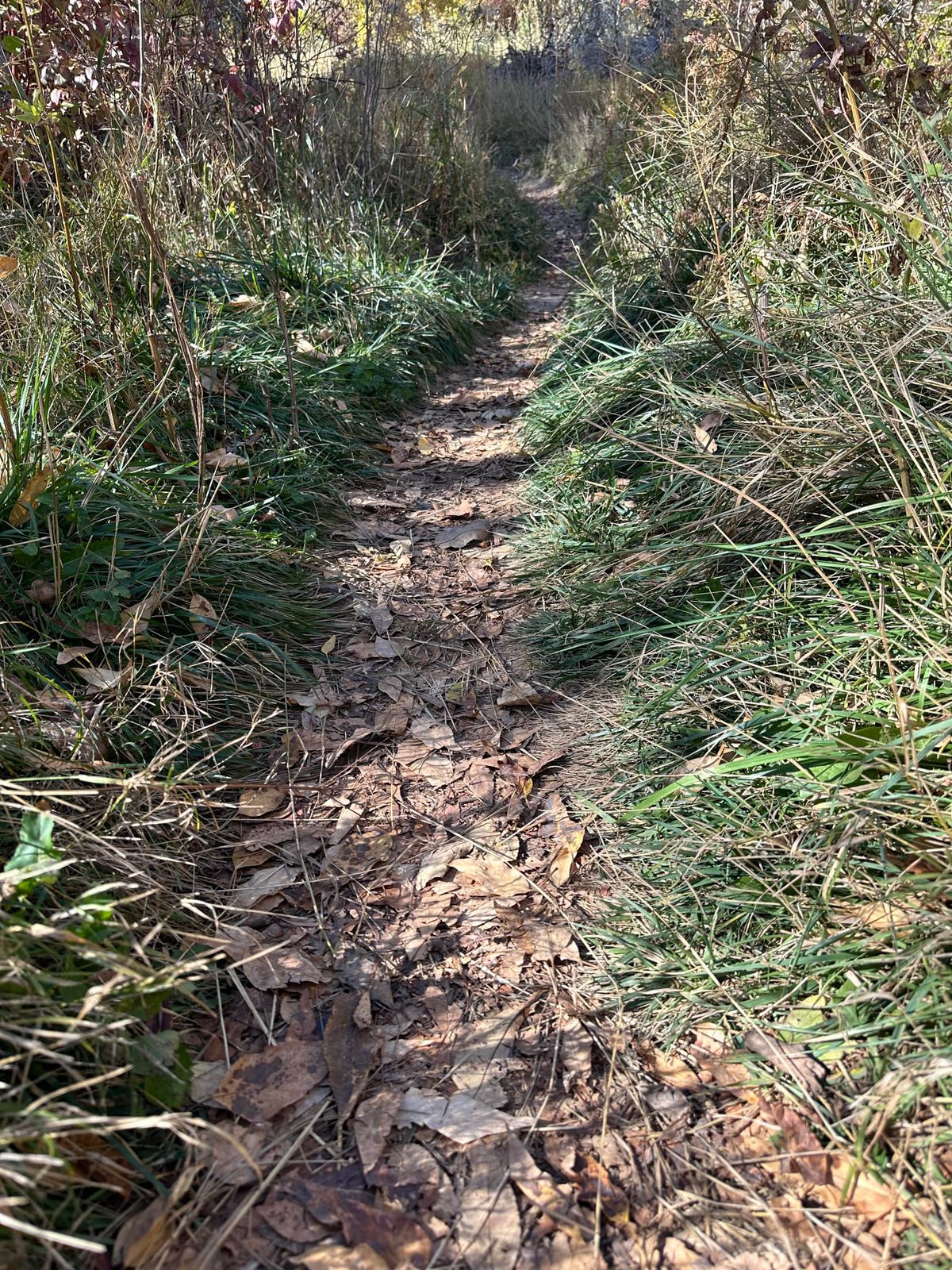
Photo by the author
ROBERT FROST WROTE about two paths he came across in the woods, much like the one above. The poet famously took “the one less traveled by” and mused that it made all the difference. One path “was grassy and wanted wear,” but the poet mentions that walkers had worn both paths “really about the same.”
Still, the poet says the path he chose made a difference. So, what was the difference that Frost experienced? One teacher suggests the poem means there is benefit to wandering away from the crowd. To take one’s own path is to affirm one’s singular identity. Call it individuality or self-love, the idea of doing one’s own thing is very common. Among self-reliant Americans, it’s almost a truism.
Some point to the poem’s irony. Both paths evidently had been worn about the same, which may imply neither was the road less traveled. Maybe the fact of a choice is the point, not which choice is made. The poem may have targeted a friend of Frost’s who was, shall we say, indecisive. Perhaps his friend didn’t care for serendipity, instead opting for sound decisions grounded in hard analysis. Ruminating over this path or that path can be an exercise in caution and prudence, but it can also be inconsequential, especially if each path leads to the same destination.
What causes a path in the first place is that walkers tend to follow the decisions of earlier travelers. As a traveler willingly learns from those who have gone before, so we all learn from the thoughts and ideas of our parents, aunts, uncles, teachers, bosses and so on. Pathways are important; they streamline the acquisition of knowledge by helping us avoid pointless wandering.
Scientists who study the brain have discovered that learning amounts to the brain changing itself to encode new information. It happens all the time. Whenever one learns something new, the brain changes to include the encoded information. One’s brain is never “set” and good to go for the duration. Instead, it changes all the time and for a lifetime. In a sense, the brain is plastic; it changes as it learns.
Breakthroughs in science often occur when people “think outside the box” and use their imagination to explore “thought experiments.” Einstein is an example of a great physicist who discovered pivotal concepts by urging his brain to imagine new possibilities. While scientific discovery sprung from his genius, younger scientists who follow him learn the concepts he only once imagined. But the process doesn’t end, because those who learn from Einstein effectively implant his ideas in their own brains, and these acolytes make their own discoveries. For example, in the ten years since the boson particle was discovered, new thinkers have added to the understanding of it, including a recent breakthrough that suggests previously learned tenets weren’t correct. In short, thinking outside established neuron pathways and then testing the new ideas has led to important understanding in physics. The concept of “dark matter,” for example, still is not fully understood, prompting scientists to seek new models or extensions of the “Standard Model” that could incorporate it.
For us who function in a more-average reality, this understanding of learning still is helpful. Before we get too “set in our ways,” it may be revelatory to do as Frost did and wander down a different, perhaps less-traveled, pathway. From the experience, we open ourselves to new, teachable moments and experiences. The beauty of it can be overlooked. The brain is amazingly capable of incorporating new ideas. Such neuroplasticity, the ability of the brain to adapt and change by making new connections between neurons, has no limit.
The metaphor of an “echo chamber” in which the same concept bounces around a group of like-minded people is appropriate for much of the internet and television chatter these days. An unwillingness to mull over different ideas can retard insight. As scientists challenged the early results of experiments with particle physics, so might one benefit from rethinking internal mental truisms. The path less traveled might in fact be within our own brains. And, remarkably, our brains seem to be designed for the adventure. — RJ Stewart