Not a Cloud in the Sky
Why so many contrails?
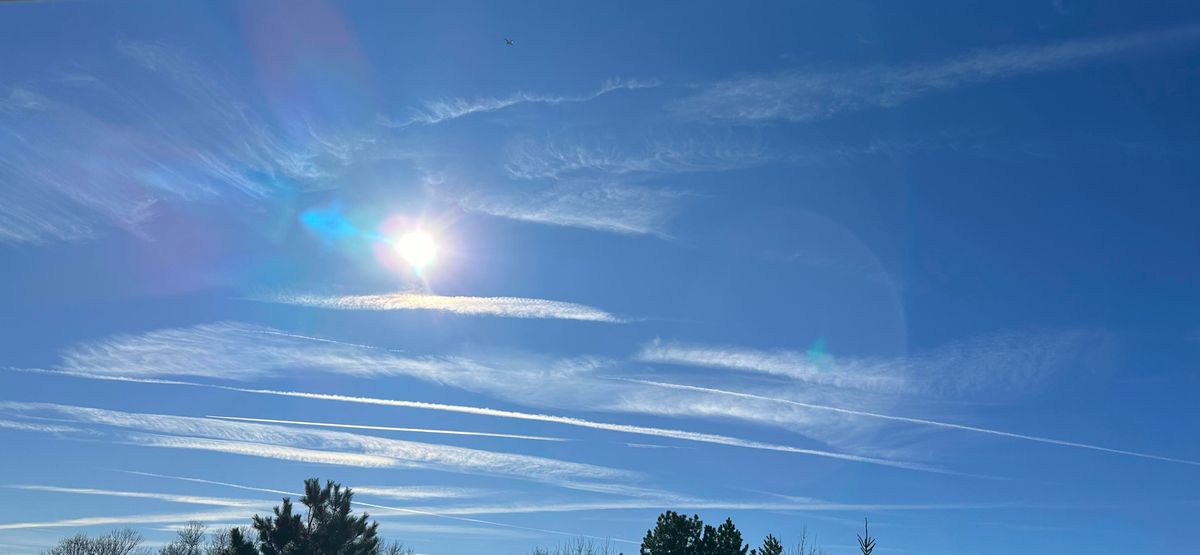
Photo credit: The Author. Research: Lewis House
The photograph above was taken just before noon a few days ago. Two or three hours earlier, the sky was nicely blue, not a cloud in the sky. Was a front moving in? No, of course not. These are just the trails of jet aircraft flying at high altitudes. Over Colorado, these condensation trails (contrails for short) vividly exhibit the voluminous air traffic high above Colorado’s fabulously beautiful Rocky Mountains.
I asked my scientific-minded friend about them, wondering just how they form and whether they contribute to “Bad Things That Are Happening Everywhere” such as human-induced climate change. From his report I learned that:
1, Unlike the automobile exhaust that a few decades ago turned the air over Denver brown (a condition which, by the way, has improved, thanks to federal demands for more efficient and cleaner engines), contrails have a different makeup. To be sure, there is “soot” in the mixture, but it’s not the principal component in contrails we see from the ground.
2, High-altitude jets burn hydrocarbon fuels, producing water vapor and other by-products such as carbon dioxide, nitrogen oxides, and sulfates. Cruising altitude for today’s passenger jets is 35,000-40,000 feet, where temperatures are routinely minus 40 Celsius, well below the freezing temperature of water. At that altitude, the air pressure is low. When the hotter and moist exhaust gases from the jet engines mix with the cold and ambient air, water vapor condenses rapidly, forming tiny water droplets that quickly freeze. What we see from the ground is a trail of ice crystals. Under certain atmospheric conditions (temperature, pressure and humidity), these ice crystals can persist and spread, forming the cirrus-like cloud cover visible from the ground.
3, At times, Earth’s atmospheric radiative balance is impacted by contrails because they can trap outgoing infrared radiation and reflect incoming solar radiation. With certain conditions, the net effect is warming.
My friend could and would do a much better job of explaining the physics of it. Suffice to say, the convenience and speed of air travel extracts a price on our climate. This was insignificant just a few decades ago, but no longer. The growth of air travel is increasing the warming effect high-altitude emissions.
Flights to and from Denver are not responsible for the contrails in the photo above, because the local air traffic occurs at lower altitudes. But Denver International Airport is exemplary of the growth of air travel. From this one airport there are on average about 850 flights per day now, about 13% more than a decade ago. Not only are high-altitude emissions on the increase, but so are ground level emissions caused by the vehicular traffic attending to the Denver airport’s many businesses.
Anyone could rant about the deleterious effects human activity such as non-essential air travel has on health and happiness. For writers and poets who are devoted to noticing stuff, it’s maddening enough just to have a nice sky defaced. Especially my Colorado sky, which I feel is my own personal property after being born here and living here for many years. Fly your stupid jet somewhere else, I’d say if I let myself, forgetting that I also frequently use the airport and its jets to enjoy the many trappings of fast travel.
But there are few, even among climate-change activists, who want to talk about something so convenient as air travel. It reunites families during holiday seasons like this one. It quickly gets us to the bedside of loved one whose health is failing. It permits long-distance commuting, and it serves our fast-paced corporate and international business needs.
Derisively, I can add that there’s no faster way to get to the next absolutely essential climate-change conference in Baku, say, than catching the international flight from Denver to Istanbul.
Sadly, we’re both blessed with — and stuck with — convenience and speed.. Although airports such as Denver’s are becoming impossibly crowded, people generally tolerate the annoying lines, flight delays, and long layovers in order to access the convenience and speed of air travel. Jets are likely here to stay, unless new technologies can be harnessed to propel molecules from one place to another. My hope is for a “molecular transporter” like the one in the 1958 movie “The Fly” — although, as we might recall, things went wrong with that, too.
In the near term at least, jet travel is here to stay. So is climate change. And, so are the many negative impacts it produces, such as my defaced Colorado sky. One can’t really close one’s eyes to the problem when it persistently mars a wonderful environmental experience such as a pure blue sky over the winter-white Rockies. Given the very observable outcome of emissions standards enforced by the federal government decades ago (if you’re old enough to remember the brown clouds over Denver and Los Angeles), perhaps there are solutions. Some mitigation has been noted by simply altering routes to avoid as much as possible the conditions that produce radiative imbalances. That’s great, but are we travelers willing to absorb the added cost of flying longer routes?
We’ll see. One can hope, as I do, for attention to the problem. I suspect, however, I’ll not live long enough to see a solution.