Installment 22
The Writing Project: Serialization of a Draft Mystery Novel
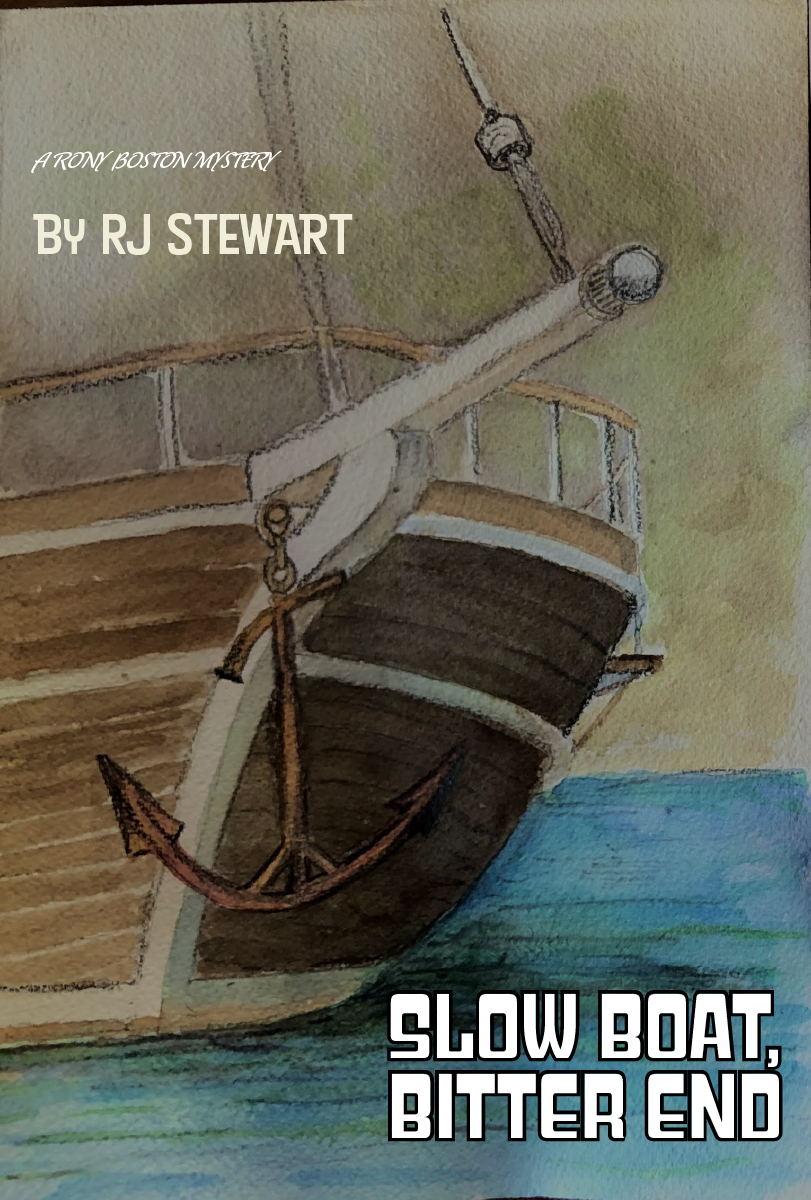
Water color by Caroline Hoyt
Working Title: “Slow Boat, Bitter End”
A Rony Boston Mystery
(This is a work of fiction. Names, characters, organizations, businesses, events, and incidents either are the product of the author’s imagination or are used fictitiously. Any resemblance to actual persons, living or dead, events, or locales is incidental. Artificial intelligence platforms are used occasionally for research but not for writing assistance.)
I’M NOT SURE how I could be languorously bouncing on Aegean waves and so shamelessly have forgotten the day’s grim events. It may have been the fun company, or perhaps the ouzo; most likely both. Maybe her mention of the waterfront brought it to mind. Suddenly, amid the insidious drunkenness, the body of Aylin, sandwiched between two planks of wood and set adrift in the sea, was before me as though I were in a confessional. How could this turn of events have happened so suddenly, so tragically, and then almost waved away? Would her body find its way to the shore? Would believers in her religion retrieve it and provide a proper burial as the captain had assured us? What if her death weren’t an accident? What if she died of malicious causes? Was evidence destroyed by a burial at sea?
Henry was waxing on, but I heard nothing. My mind returned to the capstan, the positioning of the anchor, the grisly sight of her young and beautiful body impaled on the sharp points of the anchor. And there was Gungor, frantically tugging at the anchor chain with no apparent understanding of how any of it worked or how any of it could have happened. He was the first to discover her dead body, but how was he alerted? Why was he there? Was there a history between the two of them? And why did this Bulgarian later hover over me as I stooped to examine the capstan?
Henry was talking.
… made up the part about your career as a poet, although I find it admirable. The rest I think is true, Abra. You went to Hunter and to Vassar, got a good education and then returned to your roots. And you and Judith are living happily ever after! Am I right?
God ol’ Henry. There he was, tuned in and ready to differentiate Abra’s lies from the truth. I missed what he said, so I could not agree or disagree. I’d find out when Abra owned up to her story.
Well, Henry, you are wrong, and good for you. My story of being a poet is true. I did go to Hunter and then to Vassar, although the ouzo might have helped me add a few embellishments. After I drink up, I’ll see if I can remember what I lied about.
She leaned her elbow into Judith, almost knocking her off her seat, and they both laughed away as the rest of us smiled. Merrily, she made a show of drinking ouzo number whatever-it-was. Who cared? Despite my melancholy over Aylin, I felt as giddy as anybody. The gray was beginning to lift, and the moon edged into the sky, although no longer full. We bobbed in the calm waters as Abra fleshed out her lie.
Truth is, however, my roots are not in Beaufort. My home is St. Helena, the low-country island where my ancestors grouped with other freed slaves after the Civil War. My ancestors’ heritage is tied with cotton, and that’s what my folks knew how to do. Did you know Savannah was the Southern port city from which the highly regarded low-country cotton flowed to textile factories in England? There is a house near Forsyth Park that was the residence of the ambassador from Manchester, a man with a French name, although I can’t recall it right now. That’s how close the economic ties were between Americans and their slave-grown cotton and European textile businesses. You should visit sometime, because the area is loaded with colorful history, if you think of black as being a color.
She elbowed Judith again with no result but a sad nod.
But after the war we did the best we could. My father operated a small restaurant there, and my mother had an art studio across the street. We were poor for sure, but my mother got me interested in poetry and in art.
It was Griselda who offered applause for Abra’s story and shouted a saloon-a as she raised her glass. We all followed, of course, and continued in merriment. Ruthie rose and excused herself, saying “nature calls” and we laughed at that, too. As she moved to the stairs below the decks, she slipped and nearly fell. Tad noticed and rushed to help her, but the ouzo in him was in full effect, and he upended after a few steps, knocking over Ruthie’s chair. We all laughed uproariously at the sight of the two fellow voyagers splayed on the stairs and the deck. Neil rose to help Tad, and Vasil hurried to Ruthie’s side, and soon we all were flailing on the deck like drunken sailors, which we sort of were. No one was hurt, although a few bruises were reported the next day. Ruthie went on below and the others returned to their chairs, albeit a bit wobbly. Somebody said something about the snacks running low when we heard the frightening sound of a damsel in distress: a blood-curdling scream.