Après nous, le déluge
Thoughts on America's choice for increased debt
I MEAN NO PRETENSE with the headline and subhead. I am not a historian; I speak no French.
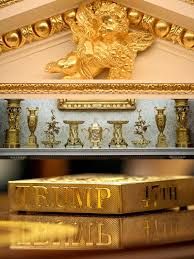
Still, recent news of the current president’s redecoration of the Oval Office describes a “Rococo” flavor that suggests the palace at Versailles, an impressive remnant of the reign of King Louis XIV.1 One parallel to French history is showy excess in the form of gold and gold-plating, but another has to do with debt.
In a Wall Street Journal article in April, the current president referred to his “gold guy” who would be doing some work in the White House. 2 The result, so far, is gaudy and gauche, as the writer for the New York Times suggests. Some think it might be OK, because as a very rich country the United States ought to be showing off its wealth. In a televised tour with FOX News personality Laura Ingraham, the current president bragged about the gold and gold-plated pieces on display. After the video was posted, many followers of Ingraham and the current president lavished praise on both the president and his taste for ostentatious wealth.
French history informs us that there can be big problems associated with showing off wealth, especially when it has been acquired on the backs of poor and middle-class people.
Versailles originally was a hunting lodge built by Louis XIII in the 17th century. His heir, Louis XIV or “Louis Quatorze’’, commissioned a remodel and then moved the seat of his government to the palace in 1682.3
It was and is lavish, but today, instead of a palace for a king, it’s a state-owned museum. As a vestige of France’s “Sun King” past, it is immensely popular; some 15 million people visit it annually. As a poignant reminder of the excesses of French royalty, especially beginning with Louis XIV, the palace of Versailles is a symbol of absolutism; that is, “ruling power that is not subject to regularized challenge or check by any other agency, be it judicial, legislative, religious, economic, or electoral.” 4
With its opulence, Versailles served Louis XIV’s purposes as a tool for political and social control, showcasing the king's authority and the grandeur of his court. When he died in 1715, ending his long reign (the longest ever for a French monarch) his heir, great-grandson Louis XV, used the palace happily. He added gardens and a little castle called Petit Trianon for his official mistress, Madame de Pompadour.5
The phrase “Après moi, le déluge” is commonly associated with Louis XIV and attributed to Louis XV with suggestion that he foretold with a tone of callous indifference the eventual revolt against the monarchy. More likely, some historians say, it was Madame Pompadour who used a variation of the phrase, Après nous, le déluge (after us, the flood).
Regardless, the comment principally has been considered both prophecy and indifference to policies that seemed to shrug off anything bad as long as it happened after one’s demise.
However, decades before the Bastille fell, French writers had used the phrase to describe the likely outcome of mortgaging the future to pay for the present. 6
In his book, Before the Deluge, Michael Sonenscher examines these fears and the monarchy’s responses to them. He argues this prelude to revolution was characterized by very high public debt caused not only by royal excess but by financing wars.7
This lesson in history is lost on the current president and his ardent sycophants. In addition to his lust for both wealth and power, his policy to reduce taxes on rich people outstrips his reckless flailing at cutting costs. The direction is not encouraging.
In a speech on Friday, JP Morgan Chase CEO Jamie Dimon sounded the alarm about debt: It will ruin the country if not checked.
A “crack” is appearing in the bond market, he went on, as a result of historically high debt plus current policies that promise to make it worse. Economists say that if investors lose confidence in the government's ability to service its debt, bonds are sold, yields go higher and the cost of borrowing increases for all Americans, including the government itself. 9
In the time of Louis XIV and Louis XV, French debt soared because of military adventures. In our time, it is a cultural war that is increases debt. Republicans like to see federal taxes reduced (especially on the wealthy), and Democrats like to see programs that build, as President Lyndon B. Johnson envisioned, a “Great Society.” Under the leadership of the current president, Republicans are unbending about reducing taxes on the wealthy. Whether Democrats are willing to negotiate is immaterial, because Trump’s policy, to House and Senate Republicans is, like those absolutists had it, “not subject to regularized challenge or check by any other agency, be it judicial, legislative, religious, economic, or electoral.”
According to the Tax Foundation, Trump’s “Big Beautiful Bill” that has passed the House has dire consequences:
As Dimon suggests, a calamitous wake-up call is on the way. There may be time to correct the trajectory, but there isn’t anything sensible in the pipeline. If a reversal doesn’t happen, we can polish our French and recite it to our children and grandchildren:
Après nous, le déluge.
https://www.nytimes.com/2025/05/27/opinion/trump-oval-office-rococo.html ↩
https://people.com/donald-trump-flew-in-gold-guy-white-house-makeover-11718960 ↩
https://en.chateauversailles.fr/discover/history#louis-xiii-and-versailles1607-1638 ↩
https://www.britannica.com/topic/absolutism-political-system ↩
https://en.chateauversailles.fr/discover/history/great-characters/madame-pompadour ↩
https://press.princeton.edu/books/paperback/9780691143262/before-the-deluge?srsltid=AfmBOopAgFOHZ4BBHvl5DR08nHPEUux37sp5Es3FWbNvAAgA45UJ-LJK ↩
https://press.princeton.edu/books/paperback/9780691143262/before-the-deluge?srsltid=AfmBOopAgFOHZ4BBHvl5DR08nHPEUux37sp5Es3FWbNvAAgA45UJ-LJK ↩
https://www.dailymail.co.uk/news/article-14766139/jamie-dimon-warning-trade-china-enemy-within.html ↩
- Federal Debt: More Than You Want to KnowSource: FRED

https://taxfoundation.org/research/all/federal/big-beautiful-bill-house-gop-tax-plan/ ↩