About hope
And signs of hope
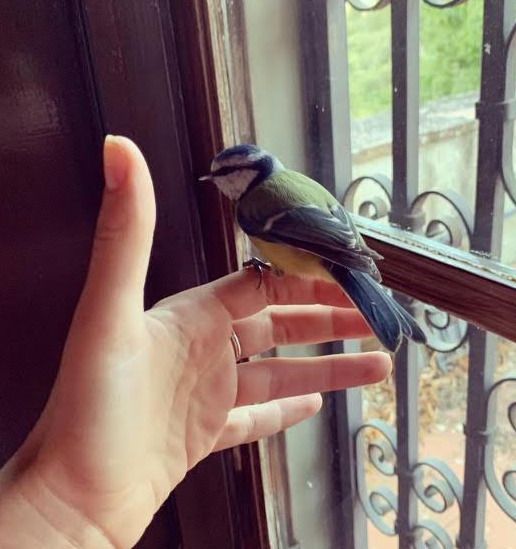
Photo by permission: J Benini
This is a real picture, a real hand, a real bird. The picture was taken in Italy a few years ago. The hand belongs to a very dear family member, a young woman who was brought up in the very house where the bird came to visit. The bird, I’m told, is a Eurasian blue tit. It is not a pet, is not trained, was not tempted with food and eventually tamed. It’s just a bird that flew in through that barred window, so typical of Tuscan farm houses. As a girl, that woman slept each childhood night just beneath that ornate window.
That a bird flew in and then perched on the woman’s hand is very uncommon. It arrived at an important moment in the young woman’s life. At the time, the young woman’s mother was ill, hospitalized in critical condition. Along with her siblings, the young woman was summoned home. Other family members arrived, too. Understandably, the mood in the household was somber.
When the bird arrived, however, things began to improve. The illness eased and soon the mother was at home again, weak but recovering. The family was tearful with joy.
There is no “artificial intelligence” that created this scene, but there may be some not-understood intelligence that was at work. Science doesn’t yet have the tools to measure this sort of phenomenon, and it may never. It’s “just one of those things” that we experience, one that brings us hope and joy.
As a writer, I seized on the event, even though I didn’t experience it first hand. It seemed perfect to illustrate in metaphorical terms a similar situation in the novel I was writing, when desperation seemed to prevail and hope seemed remote, perhaps even foolish. I wrote:
“A bird alights on my sill. Does it hope for shelter from the storm? It is not afraid. It wears an azure cap atop its white head. A thin, black line crosses its face at its eyes and ends at its tiny bill. Its shoulders and its wings are blue gray, punctuated by a thin white horizontal line. Its breast and belly are pale yellow. It is the bird Mother loves, a Eurasian blue tit. It builds its nest in the ivy vines around the villa. Does it worry for its young? When I move it flushes, but instead of going out, it comes in, flitting quickly around my bedroom. I follow it with delight, trying not to interfere. I move away from my window so it can pass. I gesture like an Italian waiter, motioning the way with my extended left hand. I say, “prego” … and it flits past me, toward the window. But then it turns suddenly toward me. It lands on my palm. Surprised and thrilled, I am afraid even to breathe. I am extraordinarily happy.”
That my character was “extraordinarily happy” is no surprise. Anyone would be thrilled. Intimate interactions with nature are rare for most of us. The character felt hope, and so did the young woman above.
Hope is an elixir, a medicine we hold dear. When hope is supported with a sign, we rejoice. Some would suggest this natural occurrence is coincidental and not related to the family’s acute emotional needs at the time. Certainly an event like this is unforgettable. We’ve been talking about it for years.
I’m reminded of it today because the unsettling election season has produced in me an uncommon funk. I am not alone. I read in the newspapers that many people are experiencing anxiety for democracy and for the health and future of their country. My personal physician a few days ago said many of her patients have noted heightened levels of fear and anxiety, even hopelessness. It’s as if an illness has taken hold of something very dear to us. A sign of hope would be most welcome.