Is Substack a boor?
I HAVEN’T POSTED to substack in a while. I have considered leaving substack altogether, but I continue to read and re-stack some of my favorite posters. So, I guess I’m lured by what I appreciate and annoyed by what I dislike. It’s easy to avoid the latter: Don’t look at it. Except that much of the annoying stuff on the internet demands attention like a two-year-old on a tantrum at the department store.
The former — what I like — takes very little effort and is often very rewarding. I follow a visual artist who calls herself “the prodigal artist.” I am not a visual artist at all, but I enjoy her work and her writing. She has told her readers of her traumatized childhood, her retreats into artistic creation, and of her long period of being fallow, like a farm field left to rest. Then she “came home” as an artist, like the the legendary prodigal son. It’s an interesting word - prodigal. It means wasteful. Maybe she considers herself to have been wasteful, perhaps of talent, perhaps of time, perhaps of love. Her sister is in poor health, and she has used her art to help her through the difficult time. That seems to me to be a very important point about people, grief, disappointment, sadness and art. Here is one of her recent pieces:
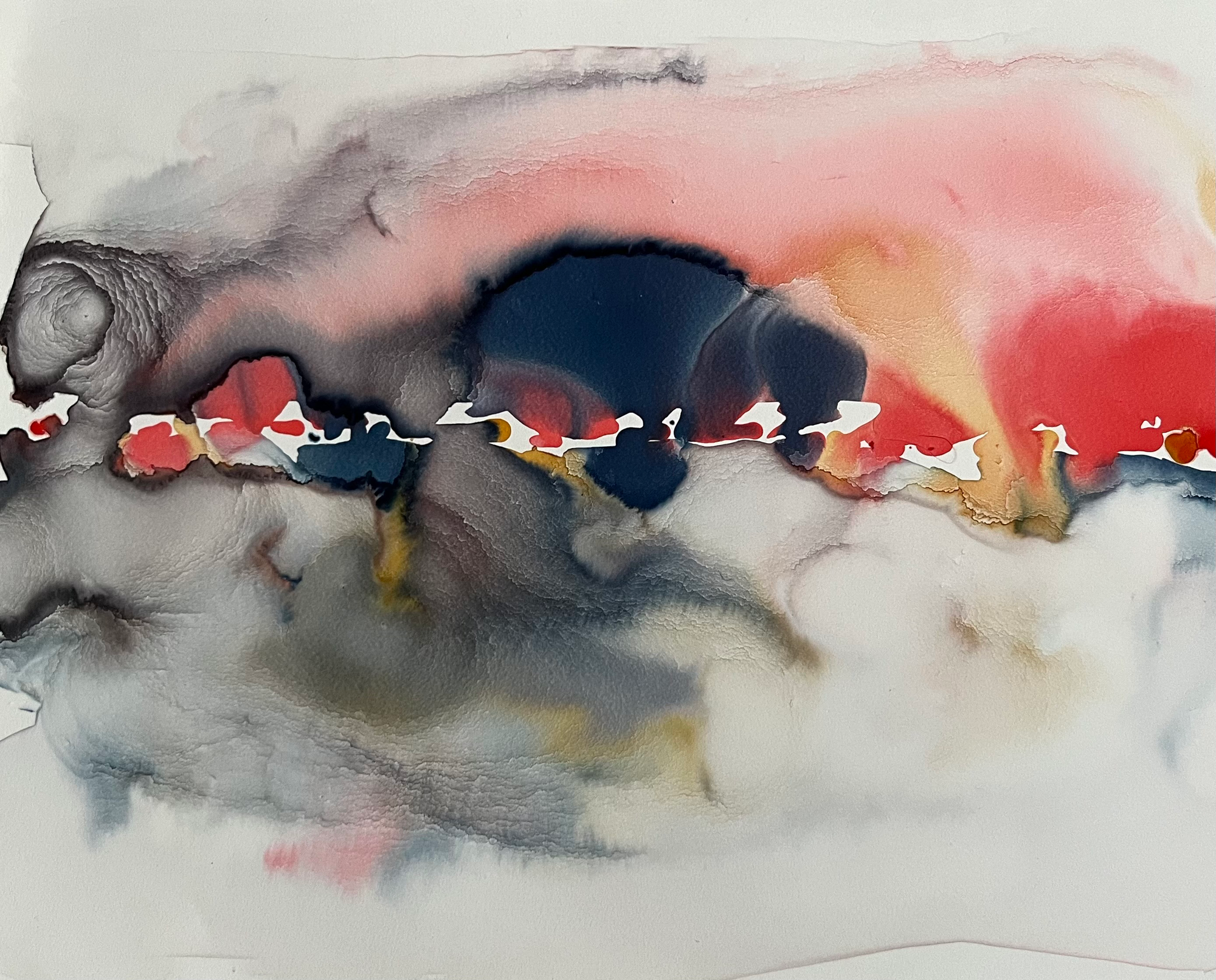
It’s abstract art I guess — I’m not knowledgeable about art. It could remind a viewer of just about anything. For me, the colors she selected (art IS choice) is what caught my eye. Then I read her accompanying article and discovered that another artist that I follow on substack had noticed the “spine” clearly running horizontally across the picture. This other artist, Kate Kern Mundie, pointed out that a spine was significant in the context of the condition of the prodigal artist’s sister: Her brain cancer had spread to her spine and she had been placed in hospice care. Now the artwork had another dimension that I had not noticed. Although obvious, it is illuminating to put words to the fact that our collective brains are richer than our singular experiences.
Ms. Mundie is an artist and a teacher — and a cook. Her substack posts often start with her art, reflect on her lessons with students, and end with a recipe. She lives in the Philadelphia area, and her work often focuses on plain life in an urban area. Here is an example:
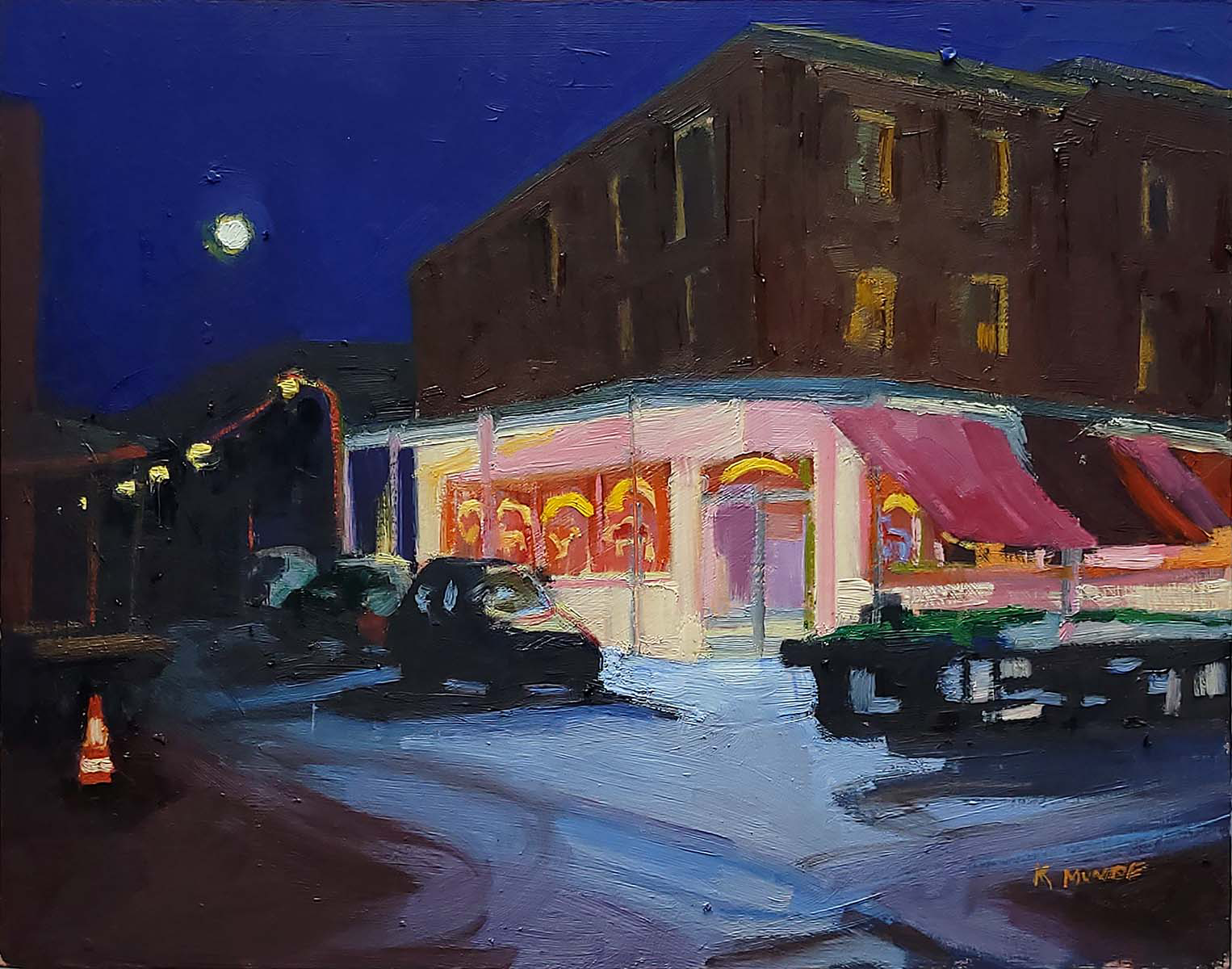
I wish I could capture a simple scene so profoundly. I wish I could sketch anything at all, because I do not seem to possess or to have learned that skill. I appreciate that she even notices this common street-corner scene, finds the beauty in it, and then finds a way to re-create it with her art. In my view, much of the richness in life involves noticing stuff, and I am often confounded by people who seem not to notice much of anything apart from their own narrow existence. It sounds very judgmental to say so, and I apologize for my haughtiness, but … noticing is a gift. Notice the cashier, notice the barista, notice the blossoms emerging from the cactus, notice the kindness of the waiter, notice the doleful look in a dog’s eyes, and all will bring emotional enrichment. The great icing on the great cake is the skill to make art of it.
Another substack contributor curates quotations and posts them with follow-up questions. The posts are called Philosophors. These inspirational quotes are one thing, and the suggested questions are another. Here’s one from a recent posting:
“Do you know what makes the prison disappear? Every deep, genuine affection. Being friends, being brothers, loving, that is what opens the prison, with supreme power, by some magic force. Without these one stays dead. But whenever affection is revived, there life revives.”
— Vincent van Gogh
Plenty to think about there, especially, or maybe in spite of, Van Gogh’s renowned mental illness. How often I’ve looked at one of his paintings, “Starry Night” for instance, and wondered about his exceptionally fine-tuned senses. You’ll of course recognize the painting, and you can place it in the context of a prison, because Van Gogh painted the scene from his asylum room at Saint-Rémy-de-Provence, just before sunrise, with the addition of an imaginary village. (I’m not sure if I’m allowed to post the painting, which has been on display at the at the Museum of Modern Art in New York City since 1941., but this link will take you there.)
And in his quote above, Van Gogh says, rather gently, that one can be trapped in a prison of one’s own making, and the release is available through “being friends, being brothers, loving …”
The post doesn’t leave it there. A question “for reflection” is added:
If love revives life, what ethical responsibility do we bear for the emotional survival of others?
To answer my own question at the top of this short essay, yes; the internet in general and substack in particular can be boring and a boor. However, to toss it out altogether, at least for now, is to not notice the baby in the bathwater. While I have in my day-to-day world a wealth of interesting people, musicians, intellects and scholars, substack broadens my reach. With music, visual art, poetry and curated quotations with questions to inspire reflection, substack can add quality to life.
Including to the dinner table, as well, because I intend to prepare the vegetarian curry pie that Ms. Mundie suggested. I’m not Jewish either, but that wonderful culture seems pleased when others use their popular exclamation: “L’Chaim!” It fits.